<?xml version="1.0"?>

<?xml-stylesheet type="text/css" body { margin-left: 10%; margin-right: 10%; }
 href="my.css"?>
<!DOCTYPE html SYSTEM "mathml.dtd">
<html xmlns="http://www.w3.org/1999/xhtml">

<head>
  <meta http-equiv="Content-Type" content="text/html" />
  <title>Algebraic Geometry</title>
</head>

<body bgcolor="#FFFFFF">
<a name="top" id="top"></a> 

<center>
<h1>Introduction to Algebraic Geometry</h1>
</center>
<center> (<em>Math 665, fall 2001</em>) </center>
<center>
Donu Arapura</center>

<center>
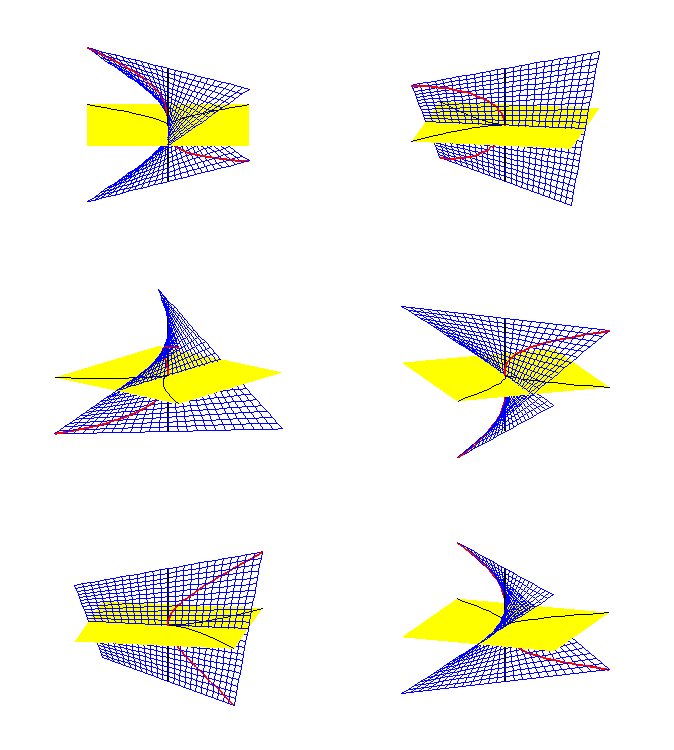
<img src="blowup.gif" /></center>

<center>
<a href="#blowup">Blow up</a></center>

<p></p>
(If this doesn't look right, use the html <a
href="./algeom.html">version.</a>) 
<ol>
  <li><a href="#top">Introduction</a></li>
  <li><a href="#books">Books</a></li>
  <li><a href="#software">Software</a></li>
  <li><a href="#about">About this web page</a></li>
</ol>

<h2>Learning the language</h2>

<p>In order to get a feeling for what algebraic geometry is, let's to go
through some examples. Consider the space of 2x2 matrices over a field k with
trace 0. This consists of  matrices of the form 
<math xmlns="http://www.w3.org/1998/Math/MathML">
  <mrow>
    <mo>(</mo>
    <mtable>
        <mtr>
        <mtd columnalign="center">
          <mi>x</mi>
        </mtd>
        <mtd columnalign="center">
          <mi>y</mi>
        </mtd>
      </mtr>
      <mtr>
        <mtd columnalign="center">
          <mi>z</mi>
        </mtd>
        <mtd columnalign="center">
          <mo>-</mo>
          <mi>x</mi>
        </mtd>
      </mtr>
    </mtable>
    <mo>)</mo>
  </mrow>
</math>
which can be identified with  points (x,y,z) of three dimensional <a
href="./algeom2.xml#affine">affine space</a> 
<math xmlns="http://www.w3.org/1998/Math/MathML">
  <msup>
    <mi fontweight="bold">A</mi>
    <mn>3</mn>
  </msup>
</math>
. In these coordinates the determinant 
<math xmlns="http://www.w3.org/1998/Math/MathML">
  <mi>det</mi>
  <mo>(</mo>
  <mi>x</mi>
  <mo>,</mo>
  <mi>y</mi>
  <mo>,</mo>
  <mi>z</mi>
  <mo>)</mo>
  <mo>=</mo>
  <mo>-</mo>
  <msup>
    <mi>x</mi>
    <mn>2</mn>
  </msup>
  <mo>-</mo>
  <mi>yz</mi>
</math>
. The determinant is an <a href="./algeom2.xml#morphism">algebraic map</a>,
and the fibers 
<p><center>
<math xmlns="http://www.w3.org/1998/Math/MathML">
  <msub>
    <mi>X</mi>
    <mi>t</mi>
  </msub>
  <mi></mi>
  <mo>=</mo>
  <mi></mi>
  <msup>
    <mi>det</mi>
    <mrow>
      <mo>-</mo>
      <mn>1</mn>
    </mrow>
  </msup>
  <mo>(</mo>
  <mi>t</mi>
  <mo>)</mo>
  <mi></mi>
  <mo>=</mo>
  <mi></mi>
  <mo>{</mo>
  <mo>(</mo>
  <mi>x</mi>
  <mo>,</mo>
  <mi>y</mi>
  <mo>,</mo>
  <mi>z</mi>
  <mo>)</mo>
  <mo>|</mo>
  <mi>det</mi>
  <mo>(</mo>
  <mi>x</mi>
  <mo>,</mo>
  <mi>y</mi>
  <mo>,</mo>
  <mi>z</mi>
  <mo>)</mo>
  <mo>=</mo>
  <mi>t</mi>
  <mo>}</mo>
  <mtext></mtext>
</math>
</center></p>
are <a href="./algeom2.xml#algset">algebraic subsets</a> of 
<math xmlns="http://www.w3.org/1998/Math/MathML">
  <msup>
    <mi fontweight="bold">A</mi>
    <mn>3</mn>
  </msup>
</math>
. These are in fact <a href="./algeom2.xml#variety">varieties</a> since the
polynomials 
<math xmlns="http://www.w3.org/1998/Math/MathML">
  <msup>
    <mi>x</mi>
    <mn>2</mn>
  </msup>
  <mo>-</mo>
  <mi>yz</mi>
  <mo>-</mo>
  <mi>t</mi>
  <mtext></mtext>
</math>
are irreducible for each t in k.</p>

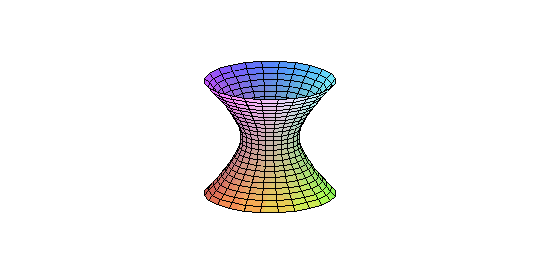
<p>Let's study the geometry of these sets. Suppose k=<strong>C</strong>, then
I claim that 
<math xmlns="http://www.w3.org/1998/Math/MathML">
  <msub>
    <mi>X</mi>
    <mi>t</mi>
  </msub>
</math>
is <a href="./algeom2.xml#morphism">isomorphic</a> to 
<math xmlns="http://www.w3.org/1998/Math/MathML">
  <msub>
    <mi>X</mi>
    <mn>1</mn>
  </msub>
</math>
whenever t is nonzero. To see this, choose a such that 
<math xmlns="http://www.w3.org/1998/Math/MathML">
  <msup>
    <mi>a</mi>
    <mn>2</mn>
  </msup>
  <mo>=</mo>
  <mi>t</mi>
</math>
, then the map 
<math xmlns="http://www.w3.org/1998/Math/MathML">
  <mo>(</mo>
  <mi>x</mi>
  <mo>,</mo>
  <mi>y</mi>
  <mo>,</mo>
  <mi>z</mi>
  <mo>)</mo>
  <mo>&RightArrow;</mo>
  <mo>(</mo>
  <mi>ax</mi>
  <mo>,</mo>
  <mi>ay</mi>
  <mo>,</mo>
  <mi>az</mi>
  <mo>)</mo>
</math>
defines an <a href="./algeom2.xml#morphism">isomorphism</a> between 
<math xmlns="http://www.w3.org/1998/Math/MathML">
  <mi>X</mi>
  <msub>
    <none/>
    <mn>1</mn>
  </msub>
</math>
and 
<math xmlns="http://www.w3.org/1998/Math/MathML">
  <msub>
    <mi>X</mi>
    <mi>t</mi>
  </msub>
</math>
; this can be checked by comparing <a href="./algeom2.xml#coord">coordinate
rings.</a> ( This works even if <strong>C</strong> is replaced by an
algebraically closed field. But it fails in general. For example when k
=<strong>R</strong>, 
<math xmlns="http://www.w3.org/1998/Math/MathML">
  <msub>
    <mi>X</mi>
    <mi>t</mi>
  </msub>
</math>
is connected in it's <a href="./algeom2.xml#topology">usual topology</a> while

<math xmlns="http://www.w3.org/1998/Math/MathML">
  <msub>
    <mi>X</mi>
    <mrow>
      <mo>-</mo>
      <mn>1</mn>
    </mrow>
  </msub>
</math>
isn't.) I claim that 
<math xmlns="http://www.w3.org/1998/Math/MathML">
  <msub>
    <mi>X</mi>
    <mn>1</mn>
  </msub>
</math>
is a <a href="./algeom2.xml#homog">homogeneous space</a> which implies
that any
point looks like any other point. To see this, observe that the <a
href="./algeom2.xml#group">algebraic group</a> 
<math xmlns="http://www.w3.org/1998/Math/MathML">
  <msub>
    <mi>SL</mi>
    <mn>2</mn>
  </msub>
  <mo>(</mo>
  <mi fontweight="bold">C</mi>
  <mo>)</mo>
  <mi></mi>
</math>
acts on 
<math xmlns="http://www.w3.org/1998/Math/MathML">
  <msub>
    <mi>X</mi>
    <mn>1</mn>
  </msub>
</math>
by matrix conjugation, and that this is a transitive action.</p>

<center>
<img src="./hyperboloid.gif" /></center>

<center>

<math xmlns="http://www.w3.org/1998/Math/MathML">
  <msub>
    <mi>X</mi>
    <mn>1</mn>
  </msub>
</math>
</center>

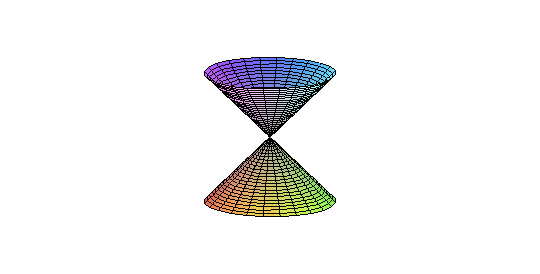
<p>
<math xmlns="http://www.w3.org/1998/Math/MathML">
  <msub>
    <mi>X</mi>
    <mn>0</mn>
  </msub>
</math>
is the space 2x2 matrices with zero trace and zero determinant. It follows by the
Cayley-Hamilton theorem that this is precisely the set of nilpotent matrices.
The zero matrix is a <a href="./algeom2.xml#sing">singular</a> point of this
set, while the other points are nonsingular. It follows that 
<math xmlns="http://www.w3.org/1998/Math/MathML">
  <msub>
    <mi>X</mi>
    <mn>0</mn>
  </msub>
</math>
is not homogenous, and therefore 
<math xmlns="http://www.w3.org/1998/Math/MathML">
  <msub>
    <mi>X</mi>
    <mn>0</mn>
  </msub>
</math>
is not isomorphic to 
<math xmlns="http://www.w3.org/1998/Math/MathML">
  <msub>
    <mi>X</mi>
    <mn>1</mn>
  </msub>
</math>
. Alternatively, these cannot be isomorphic since all the points of 
<math xmlns="http://www.w3.org/1998/Math/MathML">
  <msub>
    <mi>X</mi>
    <mn>1</mn>
  </msub>
</math>
are nonsingular.</p>

<center>
<img src="./cone.gif" /></center>

<center>

<math xmlns="http://www.w3.org/1998/Math/MathML">
  <msub>
    <mi>X</mi>
    <mn>0</mn>
  </msub>
</math>
</center>

<p>What we've been doing so far is affine geometry. We get a little more
insight into the structure of these sets by doing projective geometry. A
matrix in 
<math xmlns="http://www.w3.org/1998/Math/MathML">
  <msub>
    <mi>X</mi>
    <mrow>
      <mo>-</mo>
      <mn>1</mn>
    </mrow>
  </msub>
</math>
has 1 and -1 as its eigenvalues. The eigenvectors span two distinct lines in 
<math xmlns="http://www.w3.org/1998/Math/MathML">
  <msup>
    <mi fontweight="bold">C</mi>
    <mn>2</mn>
  </msup>
</math>
. Conversely, a pair of distinct lines determines an element of 
<math xmlns="http://www.w3.org/1998/Math/MathML">
  <msub>
    <mi>X</mi>
    <mrow>
      <mo>-</mo>
      <mn>1</mn>
    </mrow>
  </msub>
</math>
. Thus we have a bijection, and in fact isomorphism, between the 
<math xmlns="http://www.w3.org/1998/Math/MathML">
  <msub>
    <mi>X</mi>
    <mrow>
      <mo>-</mo>
      <mn>1</mn>
    </mrow>
  </msub>
</math>
and the product of two copies of the <a
href="./algeom2.xml#projective">projective line</a> minus the diagonal. Thus 
<math xmlns="http://www.w3.org/1998/Math/MathML">
  <msub>
    <mi>X</mi>
    <mrow>
      <mo>-</mo>
      <mn>1</mn>
    </mrow>
  </msub>
</math>
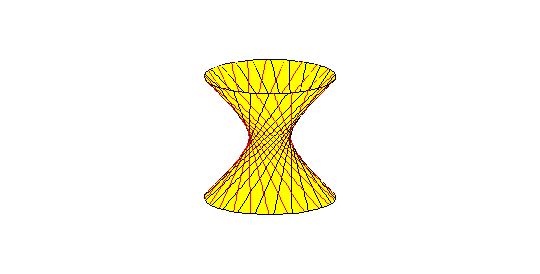
is a so called doubly ruled surface. These rulings, which are fibers of the
projections onto the factors, are embedded as lines in 
<math xmlns="http://www.w3.org/1998/Math/MathML">
  <msup>
    <mi fontweight="bold">A</mi>
    <mn>3</mn>
  </msup>
</math>
. In fact, after a linear change of coordinates the embedding of 
<math xmlns="http://www.w3.org/1998/Math/MathML">
  <msub>
    <mi>X</mi>
    <mrow>
      <mo>-</mo>
      <mn>1</mn>
    </mrow>
  </msub>
</math>
into 
<math xmlns="http://www.w3.org/1998/Math/MathML">
  <msup>
    <mi fontweight="bold">A</mi>
    <mn>3</mn>
  </msup>
</math>
extends to the <a href="./algeom2.xml#segre">Segre embedding</a> of 
<math xmlns="http://www.w3.org/1998/Math/MathML">
  <msup>
    <mi fontweight="bold">P</mi>
    <mn>1</mn>
  </msup>
  <mo>&times;</mo>
  <msup>
    <mi fontweight="bold">P</mi>
    <mn>1</mn>
  </msup>
</math>
to 
<math xmlns="http://www.w3.org/1998/Math/MathML">
  <msup>
    <mi fontweight="bold">P</mi>
    <mn>3</mn>
  </msup>
</math>
.</p>

<center>
<img src="./doublerule.gif" /></center>

<center>
Double ruling (red and black lines)</center>

<p>It follows from above that 
<math xmlns="http://www.w3.org/1998/Math/MathML">
  <msub>
    <mi>X</mi>
    <mrow>
      <mo>-</mo>
      <mn>1</mn>
    </mrow>
  </msub>
</math>
is <a href="./algeom2.xml#birat">birational</a> to the 
<math xmlns="http://www.w3.org/1998/Math/MathML">
  <msup>
    <mi fontweight="bold">P</mi>
    <mn>1</mn>
  </msup>
  <mo>&times;</mo>
  <msup>
    <mi fontweight="bold">P</mi>
    <mn>1</mn>
  </msup>
</math>
and therefore to 
<math xmlns="http://www.w3.org/1998/Math/MathML">
  <msup>
    <mi fontweight="bold">A</mi>
    <mn>2</mn>
  </msup>
</math>
. However, it is not isomorphic to 
<math xmlns="http://www.w3.org/1998/Math/MathML">
  <msup>
    <mi fontweight="bold">A</mi>
    <mn>2</mn>
  </msup>
</math>
. This is because the <a href="./algeom2.xml#coord">coordinate ring</a> 
<math xmlns="http://www.w3.org/1998/Math/MathML">
  <mi>A</mi>
  <msup>
    <mrow>
      <mo>(</mo>
      <mi fontweight="bold">A</mi>
    </mrow>
    <mn>2</mn>
  </msup>
  <mo>)</mo>
  <mo>=</mo>
  <mi>k</mi>
  <msub>
    <mrow>
      <mo>[</mo>
      <mi>x</mi>
    </mrow>
    <mn>1</mn>
  </msub>
  <mo>,</mo>
  <msub>
    <mi>x</mi>
    <mn>2</mn>
  </msub>
  <mo>]</mo>
</math>
is a unique factorization domain, while 
<math xmlns="http://www.w3.org/1998/Math/MathML">
  <mi>A</mi>
  <msub>
    <mrow>
      <mo>(</mo>
      <mi>X</mi>
    </mrow>
    <mrow>
      <mo>-</mo>
      <mn>1</mn>
    </mrow>
  </msub>
  <mo>)</mo>
  <mi></mi>
  <mo>=</mo>
  <mi>k</mi>
  <mo>[</mo>
  <mi>x</mi>
  <mo>,</mo>
  <mi>y</mi>
  <mo>,</mo>
  <mi>z</mi>
  <mo>]</mo>
  <mo>/</mo>
  <mo>(</mo>
  <mn>1</mn>
  <mo>-</mo>
  <msup>
    <mi>x</mi>
    <mn>2</mn>
  </msup>
  <mo>-</mo>
  <mi>yz</mi>
  <mo>)</mo>
</math>
isn't (the image of yz can be factored in two different ways).</p>

<center>
****</center>
<a name="blowup" id="blowup"></a> 

<p>The second example, which is the one indicated in the picture at the <a
href="#top">top</a>, is the blow up of the <a
href="./algeom2.xml#affine">affine plane</a>. This consistis of a <a
href="./algeom2.xml#qp">quasiprojective variety</a> Bl and a <a
href="./algeom2.xml#morphism">morphism</a> 
<math xmlns="http://www.w3.org/1998/Math/MathML">
  <mi>p</mi>
  <mo>:</mo>
  <mn>Bl<mrow>
    <mo>&rarr;</mo>
    <msup>
      <mi fontweight="bold">A</mi>
      <mn>2</mn>
    </msup>
  </mrow>
  </mn>
</math>
, where Bl consists of pairs (x,L) where x is point in 
<math xmlns="http://www.w3.org/1998/Math/MathML">
  <msup>
    <mi fontweight="bold">A</mi>
    <mn>2</mn>
  </msup>
</math>
and L point in <a href="./algeom2.xml#projective">
<math xmlns="http://www.w3.org/1998/Math/MathML">
  <msup>
    <mi fontweight="bold">P</mi>
    <mn>1</mn>
  </msup>
</math>
</a> containing x, and p(x,L) = x. The morphism p induces isomorphism 
<math xmlns="http://www.w3.org/1998/Math/MathML">
  <msup>
    <mi>p</mi>
    <mrow>
      <mo>-</mo>
      <mn>1</mn>
    </mrow>
  </msup>
  <msup>
    <mrow>
      <mo>(</mo>
      <mi fontweight="bold">A</mi>
    </mrow>
    <mn>2</mn>
  </msup>
  <mo>-</mo>
  <mo>{</mo>
  <mo>(</mo>
  <mn>0,0</mn>
  <mo>)</mo>
  <mo>}</mo>
  <mo>)</mo>
  <mo>&rarr;</mo>
  <msup>
    <mi fontweight="bold">A</mi>
    <mn>2</mn>
  </msup>
  <mo>-</mo>
  <mo>{</mo>
  <mo>(</mo>
  <mn>0,0</mn>
  <mo>)</mo>
  <mo>}</mo>
</math>
. Therefore p is a <a href="./algeom2.xml#birat">birational equivalence</a>.
However, p is not an isomorphism, since the preimage 
<math xmlns="http://www.w3.org/1998/Math/MathML">
  <mi>E</mi>
  <mo>=</mo>
  <msup>
    <mi>p</mi>
    <mrow>
      <mo>-</mo>
      <mn>1</mn>
    </mrow>
  </msup>
  <mo>(</mo>
  <mn>0,0</mn>
  <mo>)</mo>
</math>
is 
<math xmlns="http://www.w3.org/1998/Math/MathML">
  <msup>
    <mi fontweight="bold">P</mi>
    <mn>1</mn>
  </msup>
</math>
rather than a point. Bl can be described as a union of two affine varieties, 
<math xmlns="http://www.w3.org/1998/Math/MathML">
  <msub>
    <mi>Bl</mi>
    <mn>1</mn>
  </msub>
  <mo>=</mo>
  <mo>{</mo>
  <mo>(</mo>
  <mi>x</mi>
  <mo>,</mo>
  <mi>y</mi>
  <mo>,</mo>
  <mi>t</mi>
  <mo>)</mo>
  <mo>|</mo>
  <mi>y</mi>
  <mo>=</mo>
  <mi>xt</mi>
  <mo>}</mo>
</math>
and 
<math xmlns="http://www.w3.org/1998/Math/MathML">
  <msub>
    <mi>Bl</mi>
    <mn>2</mn>
  </msub>
  <mo>=</mo>
  <mo>{</mo>
  <mo>(</mo>
  <mi>x</mi>
  <mo>,</mo>
  <mi>y</mi>
  <mo>,</mo>
  <mi>u</mi>
  <mo>)</mo>
  <mo>|</mo>
  <mi>x</mi>
  <mo>=</mo>
  <mi>yu</mi>
  <mo>}</mo>
  <mi></mi>
</math>
glued via 
<math xmlns="http://www.w3.org/1998/Math/MathML">
  <mo>(</mo>
  <mi>x</mi>
  <mo>,</mo>
  <mi>y</mi>
  <mo>,</mo>
  <mi>t</mi>
  <mo>)</mo>
  <mi></mi>
  <mo>&rarr;</mo>
  <mi></mi>
  <mo>(</mo>
  <mi>x</mi>
  <mo>,</mo>
  <mi>y</mi>
  <mo>,</mo>
  <mn>1</mn>
  <mo>/</mo>
  <mi>t</mi>
  <mo>)</mo>
</math>
. 
<math xmlns="http://www.w3.org/1998/Math/MathML">
  <msub>
    <mi>Bl</mi>
    <mn>1</mn>
  </msub>
</math>
is blue surface depicted above.</p>

<p>The curve 
<math xmlns="http://www.w3.org/1998/Math/MathML">
  <mi>C</mi>
  <mo>=</mo>
  <mo>{</mo>
  <mo>(</mo>
  <mi>x</mi>
  <mo>,</mo>
  <mi>y</mi>
  <mo>)</mo>
  <mo>|</mo>
  <mi></mi>
  <msup>
    <mi>y</mi>
    <mn>2</mn>
  </msup>
  <mo>=</mo>
  <msup>
    <mi>x</mi>
    <mn>3</mn>
  </msup>
  <mo>}</mo>
</math>
in 
<math xmlns="http://www.w3.org/1998/Math/MathML">
  <msup>
    <mi fontweight="bold">A</mi>
    <mn>2</mn>
  </msup>
</math>
is singular at (0,0). Its preimage under p, called its total transform, is the
union of E with a curve 
<math xmlns="http://www.w3.org/1998/Math/MathML">
  <msub>
    <mi>C</mi>
    <mn>2</mn>
  </msub>
</math>
(the red curve). 
<math xmlns="http://www.w3.org/1998/Math/MathML">
  <msub>
    <mi>C</mi>
    <mn>2</mn>
  </msub>
</math>
, which can be described as the closure of the preimage of C-{(0,0)}, is
called the strict transform. This curve lies in 
<math xmlns="http://www.w3.org/1998/Math/MathML">
  <msub>
    <mi>Bl</mi>
    <mn>1</mn>
  </msub>
</math>
and is given parametrically by 
<math xmlns="http://www.w3.org/1998/Math/MathML">
  <mi>x</mi>
  <mo>=</mo>
  <msup>
    <mi>s</mi>
    <mn>2</mn>
  </msup>
  <mo>,</mo>
</math>

<math xmlns="http://www.w3.org/1998/Math/MathML">
  <mi>y</mi>
  <mo>=</mo>
  <msup>
    <mi>s</mi>
    <mn>3</mn>
  </msup>
</math>
, 
<math xmlns="http://www.w3.org/1998/Math/MathML">
  <mi>t</mi>
  <mo>=</mo>
  <mi>s</mi>
</math>
. The map 
<math xmlns="http://www.w3.org/1998/Math/MathML">
  <msup>
    <mi fontweight="bold">A</mi>
    <mn>1</mn>
  </msup>
  <mo>&rarr;</mo>
  <msub>
    <mi>C</mi>
    <mn>2</mn>
  </msub>
</math>
given by 
<math xmlns="http://www.w3.org/1998/Math/MathML">
  <mi>s</mi>
  <mo>&rarr;</mo>
  <mo>(</mo>
  <mi>x</mi>
  <mo>,</mo>
  <mi>y</mi>
  <mo>,</mo>
  <mi>t</mi>
  <mo>)</mo>
</math>
is an isomorphism, since 
<math xmlns="http://www.w3.org/1998/Math/MathML">
  <mi>t</mi>
  <mo>&rarr;</mo>
  <mi>s</mi>
</math>
is the inverse, therefore 
<math xmlns="http://www.w3.org/1998/Math/MathML">
  <msub>
    <mi>C</mi>
    <mn>2</mn>
  </msub>
</math>
is smooth. Since 
<math xmlns="http://www.w3.org/1998/Math/MathML">
  <msub>
    <mi>C</mi>
    <mn>2</mn>
  </msub>
</math>
and C are isomorphic away from (0,0), they are birational. The map on
coordinate rings 
<math xmlns="http://www.w3.org/1998/Math/MathML">
  <mi>A</mi>
  <mo>(</mo>
  <mi>C</mi>
  <mo>)</mo>
  <mo>=</mo>
  <mi>k</mi>
  <mo>[</mo>
  <mi>x</mi>
  <mo>,</mo>
  <mi>y</mi>
  <mo>]</mo>
  <mo>/</mo>
  <mo>(</mo>
  <msup>
    <mi>y</mi>
    <mn>2</mn>
  </msup>
  <mo>-</mo>
  <msup>
    <mi>x</mi>
    <mn>3</mn>
  </msup>
  <mo>)</mo>
  <mo>&rarr;</mo>
  <mi>A</mi>
  <msup>
    <mrow>
      <mo>(</mo>
      <mi fontweight="bold">A</mi>
    </mrow>
    <mn>1</mn>
  </msup>
  <mo>)</mo>
  <mo>=</mo>
  <mi>k</mi>
  <mo>[</mo>
  <mi>s</mi>
  <mo>]</mo>
</math>
is given by 
<math xmlns="http://www.w3.org/1998/Math/MathML">
  <mi>x</mi>
  <mo>&rarr;</mo>
  <msup>
    <mi>s</mi>
    <mn>2</mn>
  </msup>
</math>
, 
<math xmlns="http://www.w3.org/1998/Math/MathML">
  <mi>y</mi>
  <mo>&rarr;</mo>
  <msup>
    <mi>s</mi>
    <mn>3</mn>
  </msup>
</math>
, so A(C) can be identified with the subring of k[s] generated by 
<math xmlns="http://www.w3.org/1998/Math/MathML">
  <msup>
    <mi>s</mi>
    <mn>2</mn>
  </msup>
</math>
and 
<math xmlns="http://www.w3.org/1998/Math/MathML">
  <msup>
    <mi>s</mi>
    <mn>3</mn>
  </msup>
</math>
. 
<math xmlns="http://www.w3.org/1998/Math/MathML">
  <msub>
    <mi>C</mi>
    <mn>2</mn>
  </msub>
  <mo>&rarr;</mo>
  <mi>C</mi>
</math>
is an example of resolution of singularities.</p>
<a name="books" id="books"></a> 

<h2>Books</h2>

<p>Harris is the text for this class (although I won't follow it too
closely).</p>
This and additional references are 
<ol>
  <li>M. Atiyah,I. MacDonald, Commutative Algebra</li>
  <li>D. Cox, J. Little, D. O'Shea, Ideals, Varieties and Algorithms</li>
  <li>D. Cox, J. Little, D. O'Shea, , Using Algebraic Geometry</li>
  <li>D. Eisenbud , Commutative Algebra</li>
  <li>J. Harris, Algebraic geometry: a first course</li>
  <li>R. Hartshorne, Algebraic geometry*</li>
  <li>D. Mumford, Red book of varieties and schemes*</li>
  <li>I. Shafarevich, Basic Algebraic Geometry</li>
</ol>
The starred references would be a little heavy going as an introduction. <a
name="software" id="software"></a> 

<h2>Software</h2>
If you're comfortable with computers, there are a couple of software packages
that might help with working out examples. For general purpose algebraic
manipulation, graphics etc. there's <a
href="http://www.maplesoft.com">Maple</a> or <a
href="http://www.wri.com/">Mathematica</a>. (I tend to use Maple since it's is
available on most of our machines including all our Suns.) Some examples of
the use of Maple for algebro-geometric calculations can be found in the books
of Cox et. al. Here, I'll just give the code for generating the graph of the
blow up at the <a href="#top">top</a> of this page. 

<blockquote>
  with(plots): Bl := plot3d([x,x*t, t], x=-1..1, t=-1..1, style=WIREFRAME,
  color =blue): 

  <p>A2 := plot3d([x,y,0], x=-1..1, y=-1..1, color=yellow,
  style=PATCHNOGRID):</p>

  <p>E := spacecurve([0,0,t], t=-1..1, color=black, thickness=2):</p>

  <p>C := spacecurve([s^2, s^3, 0], s=-1..1, color=black, thickness=1):</p>

  <p>C2 := spacecurve([s^2,s^3,s], s=-1..1, color=red, thickness=2):
  display({Bl,A2, E, C, C2});</p>
</blockquote>

<center>
****</center>

<p>For doing calculations in algebraic geometry and commutative algebra,
Grayson and Stillman's 
<a href="http://www.math.uiuc.edu/Macaulay2"> Macaulay2</a>
 program is more powerful than Maple or
Mathematica. Documentation is available on the <a
href="http://www.math.uiuc.edu/Macaulay2/Manual/">web</a> or as a (very big)
pdf <a href="./Macaulay2-0.8.60-book.pdf">file</a>. To get a sense for what it
can do, let's consider some simple examples. Start the program by typing M2 in
a terminal window of one of our Suns or whatever machine you're using. (If you
plan to do anything serious, you'll need to learn how to run it under
emacs.)</p>
If this doesn't work then read <a href="#path">this.</a> 

<p><b>1.</b> As a first example, let's check a special case of the
Cayley-Hamilton theorem. At the prompt (i1:) type</p>

<blockquote>
  R = QQ[x_1..x_4]</blockquote>
This sets up a polynomial ring over Q (= QQ in Macaulay) in 4 variables. Next
define the ideal I generated by det and trace of the "universal" 4x4 matrix M
by typing 

<blockquote>
  M = matrix{{x_1,x_2},{x_3,x_4}} 

  <p>D = det M</p>

  <p>T = trace M</p>

  <p>I = ideal {D, T}</p>
</blockquote>
The <a href="./algeom2.xml#algset">algebraic set</a> V(I) in 
<math xmlns="http://www.w3.org/1998/Math/MathML">
  <msup>
    <mi fontweight="bold">A</mi>
    <mn>4</mn>
  </msup>
</math>
(= space of 2x2 matrices) is the set of matrices with det= trace = 0 Let Nilp
be the set of matrices whose square vanishes. The entries of 
<math xmlns="http://www.w3.org/1998/Math/MathML">
  <msup>
    <mi>M</mi>
    <mn>2</mn>
  </msup>
</math>
generate an ideal J which can be constructed by 

<blockquote>
  J = ideal M^2</blockquote>
Then Nilp = V(J). By the Cayley-Hamilton theorem, V(I) coincides with Nilp as
well. Let's check this directly. In order verify V(I) = V(J) (over any
algebraically closed field of char. 0), it's enough, by the <a
href="./algeom2.xml#null">Nullstellensatz</a>, to check the equality of the
radicals of I and J: 

<blockquote>
  radical I == radical J</blockquote>
Exercise: check whether I = J? If not, then what goes wrong? 

<p></p>

<center>
****</center>

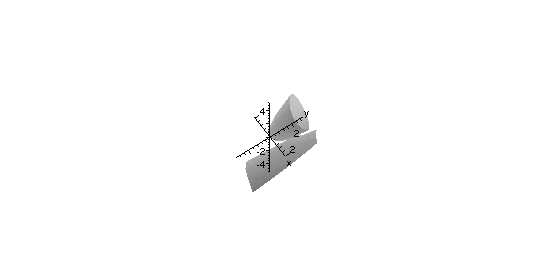
<p><b>2.</b> Next, let's check that the hypersurface 
<math xmlns="http://www.w3.org/1998/Math/MathML">
  <mi>f</mi>
  <mo>=</mo>
  <msup>
    <mi>z</mi>
    <mn>2</mn>
  </msup>
  <mo>-</mo>
  <mo>(</mo>
  <mi>y</mi>
  <mo>-</mo>
  <mn>1</mn>
  <mo>)</mo>
  <msup>
    <mrow>
      <mo>(</mo>
      <mi>y</mi>
    </mrow>
    <mn>2</mn>
  </msup>
  <mo>-</mo>
  <mi>x</mi>
  <mo>)</mo>
  <mo>=</mo>
  <mn>0</mn>
</math>
in 
<math xmlns="http://www.w3.org/1998/Math/MathML">
  <msup>
    <mi fontweight="bold">A</mi>
    <mn>3</mn>
  </msup>
</math>
has exactly one <a href="./algeom2.xml#sing">singular point</a> at (1,1,0)
over an algebraically closed field of large positive characteristic (Macaulay2
computes more efficiently over finite fields).</p>

<center>
<img src="./cubic.gif" /></center>
We need to clear the previous use of x before defining the new objects 

<blockquote>
  erase symbol x 

  <p>R = ZZ/31991[x,y,z]</p>

  <p>f = z^2 -(y-1)*(y^2-x)</p>
</blockquote>
The graph (which is a bit misleading) suggests that the hypersurface might be
reducible. We can check that it's irreducible <b>over the prime field</b>
Z/31991 by trying to factor it: 

<blockquote>
  factor f</blockquote>
Next define the ideal Jac generated by f and its partials. 

<blockquote>
  Jac = ideal { f, diff(x,f), diff(y,f), diff(z,f)}</blockquote>
The singular locus of f is precisely V(Jac). It is enough by the <a
href="./algeom2.xml#null">Nullstellensatz</a> to check the radical of Jac is
the maximal ideal (x-1,y-1,z) 

<blockquote>
  radical Jac</blockquote>

<center>
****</center>

<p><b>3.</b> For the last example, let's identify 
<math xmlns="http://www.w3.org/1998/Math/MathML">
  <msup>
    <mi fontweight="bold">A</mi>
    <mn>8</mn>
  </msup>
</math>
with space of 2x4 matrices. Consider the <a
href="./algeom2.xml#morphism">morphism</a> 
<math xmlns="http://www.w3.org/1998/Math/MathML">
  <mi>P</mi>
  <mo>:</mo>
  <msup>
    <mi fontweight="bold">A</mi>
    <mn>8</mn>
  </msup>
  <mo>&rarr;</mo>
  <msup>
    <mi fontweight="bold">A</mi>
    <mn>6</mn>
  </msup>
</math>
given by sending a matrix to the vector of its 2x2 minors (in some order). Let
X be the image of F, and let's find <a href="./algeom2.xml#null">I(X)</a>. (In
more geometric terms, we're determining the Pluecker equations for the
Grassmanian of 2-planes in affine 4-space.) Let R and S be the coordinate
rings of these affine spaces.</p>

<blockquote>
  erase symbol x 

  <p>erase symbol y</p>

  <p>R = QQ[x_1..x_8]</p>

  <p>S = QQ[y_1..y_6]</p>
</blockquote>
Let p be homomorphism from S -&gt; R determined by P. 

<blockquote>
  M = genericMatrix(R,x_1,2,4) 

  <p>M2 = exteriorPower(2,M)</p>

  <p>p = map(R,S, M2)</p>
</blockquote>
Then I(X) = ker(p) 

<blockquote>
  ker p</blockquote>
When we're finished, type 

<blockquote>
  quit</blockquote>
Back to <a href="#top">beginning.</a> 

<p></p>

<center>
--------------------------------------------------------</center>
<a name="path" id="path"></a> 

<p> This information is relevant for people usings Suns at 
Purdue Math only: </p> 
<p>If "M2" doesn't work, it means that the command is not on your path. You'll
need to <a href="http://www.math.purdue.edu/~bell/Computers/news1.html">add
it.</a> Unfortunately, there are two different locations in our dept.
depending on the version of the operation system.</p>
Type 

<blockquote>
  uname -r</blockquote>
If it's 5.5.1, use /opt/Macaulay2-0.8.60/bin If it's 5.8, use
/pkgs/macaulay2-8.60/bin/ If all else fails, you can use my personal version
/.amd_mnt/banach//export/u7/dvb/Macaulay2/bin on a Solaris 5.8 machine.

<p>Mathematics may be timeless, but this information certainly isn't. If things
don't work in the future, check here again. <a name="about"
id="about"></a> 
(Note: I'm currently, as of fall '02, running linux on my office machine,
so I probably won't bother updating the Sun stuff.)
</p>
<p></p>

<center>
--------------------------------------------------------</center>

<p>This web page was created on a <a href="http://www.apple.com">Mac</a>
running  <a href="http://www.yellowdoglinux.com/">yellowdog linux</a> 
 and MacOS9, with amaya, emacs,
itex2html, mozilla, Macaulay2, Maple, GifBuilder (the latter two running under
MacOS). The equipment was purchased through an NSF grant.</p>

<p> Last revision 11/08/02 </p>
</body>
</html>