Outreach module (grades 9-12)

Fifteen Puzzle Explorer

Part 6: Solution guide

From theorem to method

Part 5 tells you when a board can be solved. This page turns to the constructive question: once a board is solvable, how do you actually solve it?

We begin with one complete 7-puzzle solution, because every move can be seen clearly on the smaller board. Then we use that example to organize the fifteen puzzle into three overlapping 7-puzzle strips.
Work beside the example

Keep a board open while you read. Focus the board, then use Arrow keys or WASD. Click or tap a neighboring tile to slide it.

7 puzzle board. 2 rows and 4 columns. Blank at row 2, column 4.

Puzzle selector

Choose a start and make your first move.

Stats

Moves: 0

Time: 00:00

Best solved runs: none yet

Board state

1. A worked 7-puzzle example

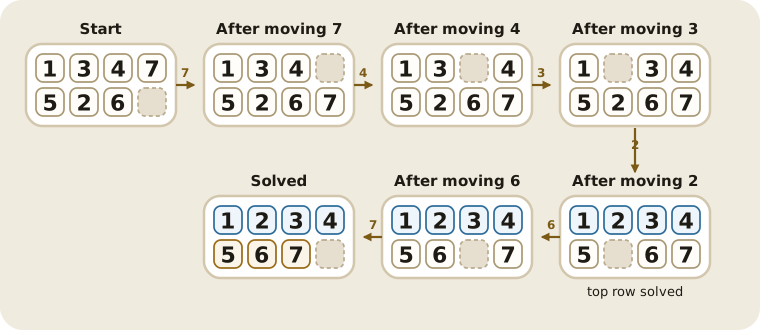
Start with this solvable 7 puzzle.

The starting 7-puzzle board has top row 1, 3, 4, 7 and bottom row 5, 2, 6, blank.

The six moves below solve this board. After the fourth move, the top row is in order. The last two moves finish the bottom row.

Seven small 7-puzzle boards are arranged in a path showing one complete solution. The top row is solved after the fourth move, and the final two moves solve the bottom row.
A complete six-move solution of one solvable 7 puzzle.

2. The fifteen puzzle as three 7 puzzles

The same row-by-row method works on the 7 puzzle and on the fifteen puzzle. On the \(4\times4\) board, adjacent pairs of rows form \(2\times4\) strips. Each strip behaves like a 7 puzzle, and the three strips overlap: rows \(1\)-\(2\), rows \(2\)-\(3\), and rows \(3\)-\(4\).

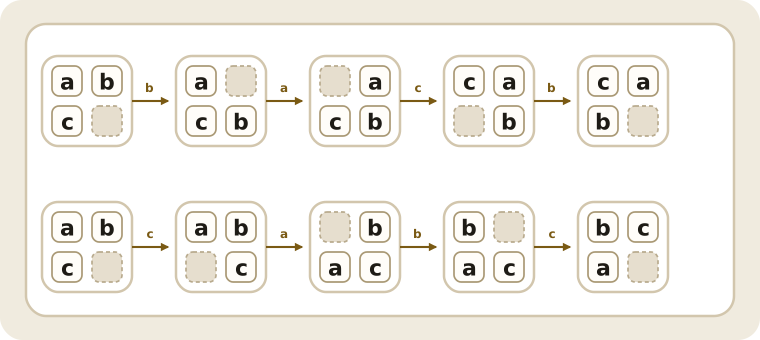
The local moves are built from short loops inside a \(2\times2\) block. Running the blank around such a square returns the blank to its corner and cycles the three numbered tiles.

Two rows of small 2-by-2 boards show local blank loops. In each row, the blank returns to its corner while the three labeled tiles cycle. The arrows between the boards are labeled only by the tile moved at each step.
Basic clockwise and counterclockwise loops inside a \(2\times2\) block.
A fifteen-puzzle board with three overlapping highlighted two-row strips: rows 1-2 in blue, rows 2-3 in dashed gold, and rows 3-4 in dashed green.
Organize the fifteen puzzle into three overlapping 7-puzzle strips.
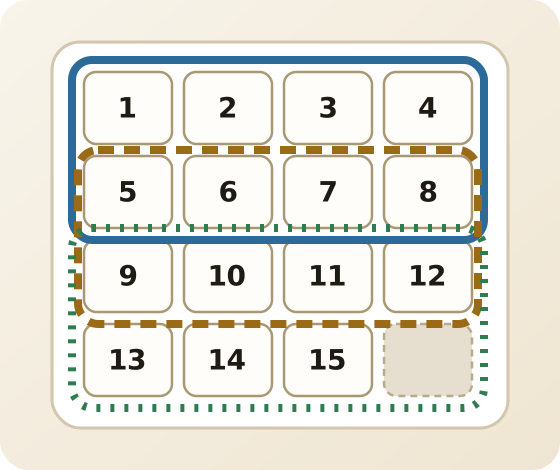
  1. First solve rows \(1\)-\(2\).
  2. Then move to rows \(2\)-\(3\), leaving row \(1\).
  3. Finally finish \(3\)-\(4\).

3. Try it

Start with the 7 puzzle on the playable board above. Once that feels comfortable, switch to the 15 puzzle and try the same row-by-row method there.