next up previous
Next: About this document ...

Solutions 2.

1.
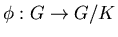
(Correspondence Theorem) Let K be a normal subgroup of a group G and $\phi: G \rightarrow G/K$the canonical homomorphism. Prove that:
(a)
The subgroups of G/K are in 1-1 correspondence with the set of subgroups of G which contain K.
(b)
For any subgroups $A \subset B$ of G containing K, A is a normal subgroup of B iff $\phi(A)$ is a normal subgroup of $\phi(B)$ and in this case $(B:A) = (\phi(B):\phi(A)) $.

Solution sketch:
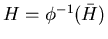
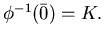
(a) For every subgroup $\bar{H}$ of G/K, consider the subgroup $H = \phi^{-1}(\bar{H})$ of G. Clearly, $H \supset K,$because $\phi^{-1}(\bar{0}) = K .$Now show that this correspondence is a bijection.
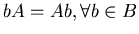
(b) $K \subset A \subset B \subset G .$ Clearly, A normal in B implies $bA = Ab, \forall b \in B$which implies that $\phi(b)\phi(A) = \phi(A)\phi(b), \forall b\in B$, and hence $\phi(A)$ is normal in $\phi(B)$. To show the converse, assume that $\bar{b}\phi(A) = \phi(A)\bar{b} \forall \bar{b} \in \phi(B).$ Let $\bar{b} = \phi(b)$. Then, (bK)(AK) = (AK)(bK). But since K is normal and contained in A, we have that KA = AK = A, Kb = bK, and thus bA = Ab.
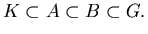
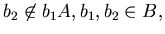
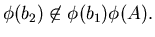
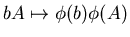
There is a 1-1 correspondence between the cosets bA of A in B, and the cosets $\bar{b}\phi(A)$ of $\phi(A)$ in $\phi(B)$ where bA corresponds to $\phi(b)\phi(A).$If $b_2 \not\in b_1A, b_1,b_2 \in B,$ then $\phi(b_2) \not\in \phi(b_1)\phi(A).$ If not, then b2K = (b1K)(aK) for some $a \in A,$ which will imply that b2K = b1aK and hence $b_2 \in b_1A .$Since the map, $bA \mapsto \phi(b)\phi(A)$ is clearly onto, and we have just proved it is 1-1, we have $(B:A) = (\phi(B):\phi(A)) $.

2.
The aim of this exercise is to show that there exists no simple group of order 30.
(a)
Count the number of elements in all 5-Sylow subgroups.
(b)
Count the number of elements in all 3-Sylow subgroups.
(c)
Conclude that there does not exist a simple group of order 30 (be careful).
Solution:
Assume that G is simple and |G| = 30 .
(a) Since the number of 5-Sylow subgroups have to divide 30 and be equal 1 mod 5, it is 1 or 6. If it is 1 then the unique 5-Sylow subgroup would be normal contradicting that G is simple. Hence, the number must be 6. Moreover, since they are all cyclic groups of a prime order, two of them cannot have any non-trivial element in common (otherwise that element would generate both). Therefore, the total number of elements in 5-Sylow subgroups excluding the identity is $6\times 4 = 24.$

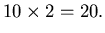
(b) Similarly, there are 10 3-Sylow subgroups and the number of non-identity elements is $10 \times 2 = 20 .$

(c) The set of elements in (a) is disjoint from those of (b) (they have different periods). This leads to a contradiction as 24 + 20 > 30 .

3.
In this problem p is a prime.
(a)
Use the class equation to prove that every p-group has a non-trivial center.
(b)
Let G be a group and H a subgroup of the center of G. Prove that G is Abelian if G/H is cyclic. (Note that His automatically a normal subgroup being contained in the center).
(c)
Prove that any group of order p2 is Abelian.
(d)
Show that there exists exactly two non-isomorphic groups of order p2.
Solution:
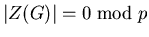
(a) The class equation tells us that $\vert G\vert = \vert Z(G)\vert + \sum_{x \in C} (G:N_x),$ where Z(G) is the center of G and C is a set of representatives from conjugacy classes. If G is a p-group then |G|,(G:Nx) are all 0 modulo p. Hence, $\vert Z(G)\vert = 0 \;\mbox{mod}\; p$. But, Z(G) contains the identity and hence $\vert Z(G)\vert \geq 1 $. This implies that |Z(G)| > 1.
Let gH generate the cyclic group G/H. Let g1,g2 be any two elements of G.
Let, g1H = giH, g2H = gjH. Clearly, g1g2H = g2g1H = gi+jH .But $H \subset Z(G),$ and thus every element of H commutes with every element of G.
Now, g1 = gi h1, g2 = gj h2 for some $h_1,h_2 \in H .$Taking advantage of the commutativity of elements of H we have that, g1g2 = gi h1 gj h2 = gi+jh1h2 = gjh2 gih1 = g1g2. Thus, G is Abelian.

(c) Let |G| = p2. By part (a) Z(G) is non-trivial. Hence, |Z(G)| can be either p2or p. In the former case we are done. If |Z(G)| = p then, G/Z(G) has order p and hence cyclic. Now apply part (c).

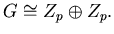
(d) Let |G| = p2. We know that G is Abelian and p| |G|. Hence, there exists an element a of order p in G and let $H_1 = \langle a \rangle$. Let $b \in G\setminus H_1.$ The period of b is either p or p2 . In the former case, let $H_2 = \langle b \rangle$. Clearly, $\vert G\vert = \vert H_1\vert\vert H_2\vert, H_1 \cap H_2 = \{e \}$ and hence $G \cong Z_p \oplus Z_p .$In the latter case, G is cyclic of order p2 .
4.
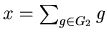
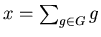
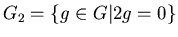
Let G be a finite, Abelian group written additively. Let $x = \sum_{g \in G} g$, and let G2 be the subgroup of G consisting of all elements of period 2, i.e. $G_2 = \{g \in G \vert 2g = 0 \}$.
(a)
Show that $x = \sum_{g \in G_2} g$.
(b)
Show that x = 0 if $\vert G_2\vert \neq 2$. If |G2| = 2, show that x is the unique non-zero element of G2.
(c)
Show that |G2| = 2, iff the 2-Sylow subgroup of G is cyclic and non-trivial.

(d)
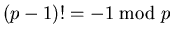
Let p be prime. Show that $(p-1)! = -1\; \mbox{mod}\;p$ (Wilson's Theorem). (Hint. Apply part (b) to the multiplicative group ( $\mbox{mod}\;\; p$) $Z_p = \{1,2,\ldots,p-1 \} .$)
Solution:
(a) $x = \sum_{g \in G_2}g + \sum_{g \in G\setminus G_2} g$. Now, in the second summation, every $g \in G\setminus G_2$ has period not equal to 2, and hence g is not an inverse of itself. Moreover, $g \in G\setminus G_2 \Longrightarrow -g \in G\setminus G_2.$ Thus, every element in the second sum can be paired of with its inverse, making the sum 0. Hence, $x = \sum_{g \in G_2} g$.

(b) Every element other than 0 in G2 has period 2. Thus, |G2| must be a power of 2 (say 2m). Choose m different non-zero elements of G2, $a_1,\ldots,a_m$. Then, $G_2 = \langle a_1\rangle \oplus\cdots \oplus \langle a_m\rangle$ (using the theorems of direct sums). Clearly, if m > 1 then summing over all elements of G2 will produce 0 (just verify component-wise). When m=1, x = a1 the unique non-zero element.
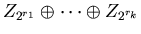
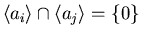
(c) If |G2| = 2 then the unique 2-Sylow subgroup is non-trivial (has to contain G2) and has exactly one element x of order 2. Now, the 2-Sylow subgroup being an Abelian 2-group is isomorphic to a direct sum $Z_{2^{r_1}} \oplus \cdots\oplus Z_{2^{r_k}}$. Let, $a_1,\ldots,a_k$ be the generators of the corresponding cyclic groups. But, 2ri -1ai has period 2 and must equal xfor $1 \leq i \leq k .$But, the 2-Sylow subgroup is a direct sum of the $\langle a_i \rangle$, and hence $\langle a_i \rangle \cap \langle a_j \rangle = \{0\}$ for $i \neq j$. Hence, k has to be 1 and the 2-Sylow subgroup must be cyclic.
Conversely, if the 2-Sylow subgroup is non-trivial cyclic with generator a of order $2^{r}, r\geq 1,$it has exactly one element of order 2, namely 2r-1a, and hence |G2| = 2.
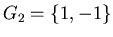
(d) The multiplicative group of the field Fp is Abelian. Also, the equation x2 -1 has exactly two solutions 1,-1 . Thus, applying part (b) we have that the product of all elements is equal to the unique non-identity in $G_2 = \{1,-1\}$, which is -1. (Note that, we are using multiplicative notation here and so sums are written as products, the identity is 1 etc., but since the underlying group is Abelian we can use the results of part (a) and (b).


next up previous
Next: About this document ...
Saugata Basu
2000-09-28