(I) Introduction
Definition
A complex number is a number written in the form \( z = a + bi \), where \( a \) and \( b \) are real numbers and \( i \) is a formal symbol satisfying \( i^2 = -1 \).
- \( a \) is the real part of \( z \), denoted by \(\text{Re } z\).
- \( b \) is the imaginary part of \( z \), denoted by \(\text{Im } z\).
A real number \( a \) is considered as a special type of complex number by identifying \( a \) with \( a + 0i \).
Conjugate and Modulus:
- The conjugate of \( z = a + bi \) is \( \overline{z} = a - bi \).
- The modulus of \( z \) is \( |z| = \sqrt{z\overline{z}} = \sqrt{a^2 + b^2} \).
Some Properties
- \( \overline{z} = z \) if and only if \( z \) is a real number.
- \( \overline{w + z} = \overline{w} + \overline{z} \)
- \( \overline{wz} = \overline{w}\overline{z} \)
(In particular, \( \overline{rz} = r\overline{z} \) if \( r \) is real) - \( z\overline{z} = |z|^2 \ge 0 \)
- \( |wz| = |w||z| \)
- \( |w + z| \le |w| + |z| \) (Triangle Inequality)
- If \( z \ne 0 \), then \( |z| > 0 \) and \( z \) has a multiplicative inverse denoted by \( \frac{1}{z} \) or \( z^{-1} \) and given by \( \frac{1}{z} = \frac{\overline{z}}{|z|^2} \).
Let \( w = 3 + 4i \) and \( z = 5 - 2i \). Compute \( z\overline{z} \), \( |z| \), and \( \frac{w}{z} \).
Solution:
(II) Geometric Interpretation and Polar System
\( z = a + bi \) corresponds to a point \( (a, b) \) in the plane \( \mathbb{R}^2 \).
- The horizontal axis is the real axis.
- The vertical axis is the imaginary axis.
- \( \overline{z} = a - bi \): The complex conjugate is a mirror image across the real axis.
- \( \vec{w} + \vec{z} \): Addition of complex numbers behaves like vector addition (parallelogram rule).
To give a graphical representation of complex multiplication, we use polar coordinates in \( \mathbb{R}^2 \).
Given a nonzero complex number \( z = a + bi \):
Let \( \varphi \) be the angle between the positive real axis and the point \( (a, b) \). This is the principal value of the argument of \( z \), where \( -\pi < \varphi \le \pi \).
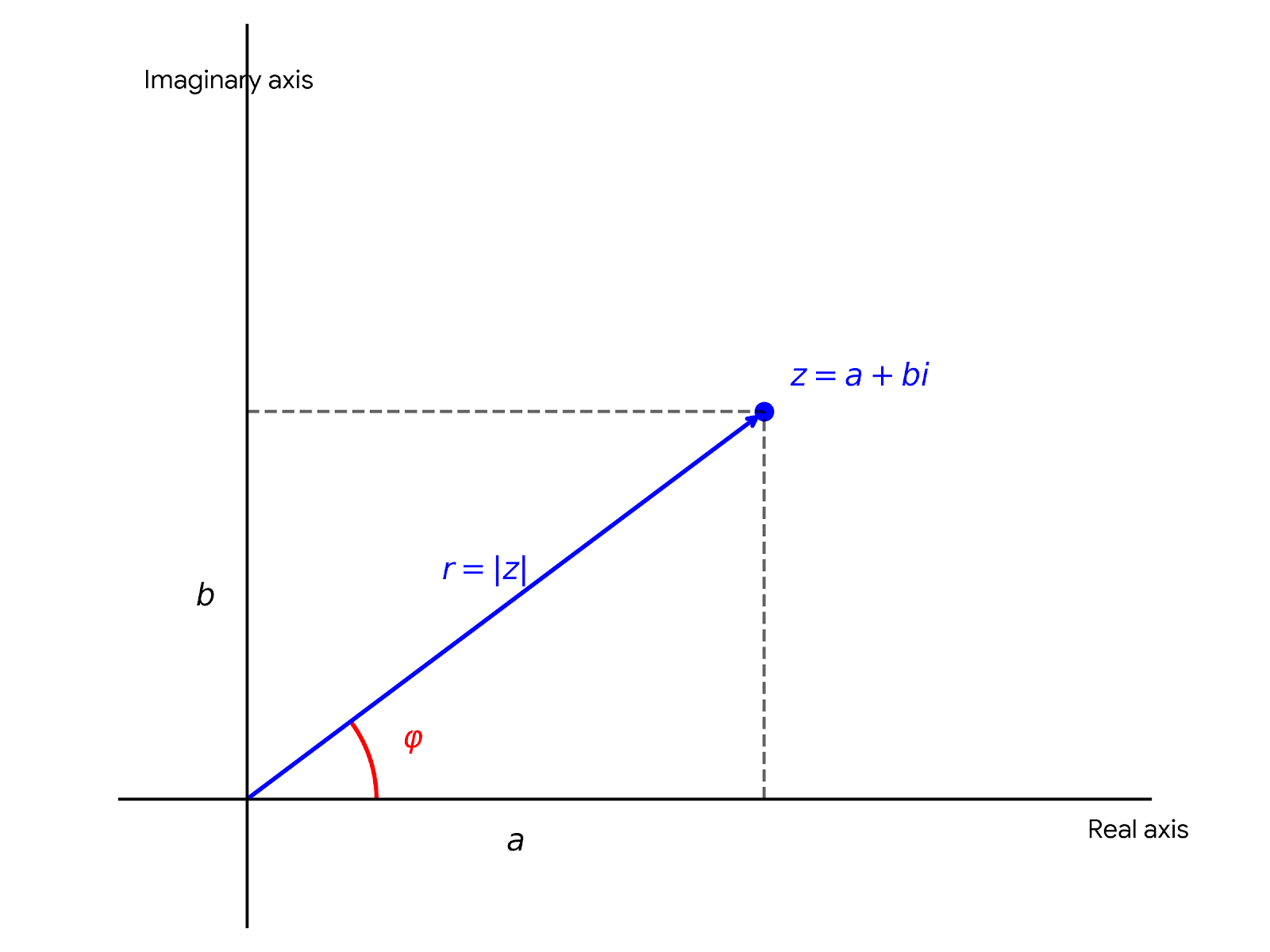
We can write \( z \) as:
Euler's Formula
This allows us to write complex numbers in exponential form:
Let \( z = |z|e^{i\varphi} \) and \( w = |w|e^{i\theta} \). The rules for multiplication, division, and powers are:
Find all real and complex roots of the equation \( x^5 = 32 \).
Solution:
We can write \( 32 \) in polar form as \( 32 = 32e^{2\pi k i} \), where \( k \) is any integer.
We restrict the angle \( \frac{2\pi k}{5} \) to the principal range \( (-\pi, \pi] \). This gives the integer values \( k = -2, -1, 0, 1, 2 \).
The 5 roots are:
- \( k = -2 \implies x = 2e^{-\frac{4\pi}{5}i} \)
- \( k = -1 \implies x = 2e^{-\frac{2\pi}{5}i} \)
- \( k = 0 \implies x = 2e^{0} = 2 \)
- \( k = 1 \implies x = 2e^{\frac{2\pi}{5}i} \)
- \( k = 2 \implies x = 2e^{\frac{4\pi}{5}i} \)
(III) Theorem on Conjugate Pair Zeros of a Polynomial
If a polynomial \( f(x) \) of degree \( n \) has real coefficients and if \( z = a + bi \) with \( b \ne 0 \) is a complex zero of \( f(x) \), then the conjugate \( \overline{z} = a - bi \) is also a zero of \( f(x) \).
Find all real and complex eigenvalues of the matrix:
\[ A = \begin{bmatrix} 1 & 0 & 0 \\ 0 & 3 & 2 \\ 0 & -5 & 5 \end{bmatrix} \]Solution: Find the characteristic polynomial \(\det(A - \lambda I) = 0\):
From \( 1 - \lambda = 0 \), we get \( \lambda = 1 \).
From \( \lambda^2 - 8\lambda + 25 = 0 \), use the quadratic formula:
The eigenvalues are \( \lambda = 1, 4 + 3i, 4 - 3i \).
Notice that nonreal complex eigenvalues always occur in conjugate pairs.