(I) Equilibrium Solution
In previous sections we have often used explicit solutions of differential equations to answer specific numerical questions. But even when a given differential equation is difficult or impossible to solve, it is often possible to extract qualitative information about general properties of its solution. For example, as time \(t\) approaches infinity, \(x(t)\) grows without bound or approaches a finite limit.
Consider an autonomous first-order differential equation in which the independent variable \(t\) does not appear explicitly:
The solutions of \(f(x) = 0\) are called critical points. If \(x = c\) is a critical point, then the constant-valued function \(x(t) \equiv c\) is called an equilibrium solution.
(II) Stability of Critical Points
Consider the logistic differential equation: $$\frac{dx}{dt} = kx(M - x) \quad \text{with } x(0) = x_0$$
Critical Points: \(f(x) = kx(M - x) = 0 \implies x = 0, M\). This yields two equilibrium solutions: \(x \equiv 0\) and \(x \equiv M\).
Behavior analysis:
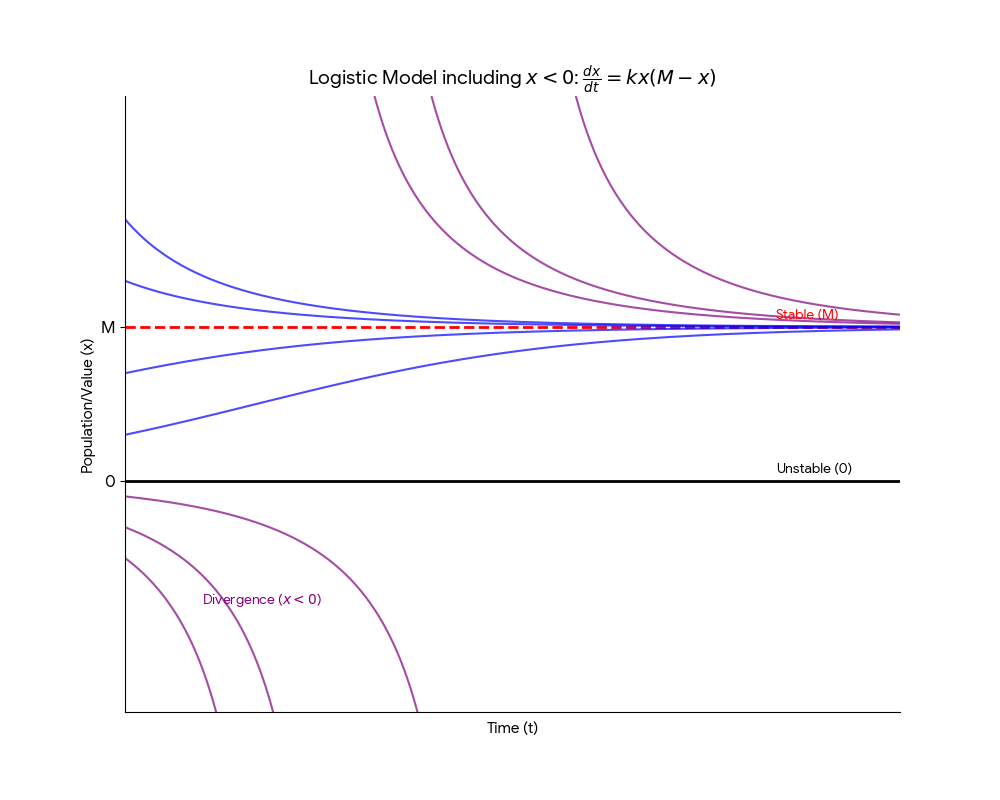
- If the initial population \(x_0 > 0\), then \(x(t)\) approaches \(M\) as \(t\) approaches infinity.
- If \(x_0 < 0\), the denominator is positive initially and then vanishes.
Phase Diagram Analysis:
- When \(0 < x < M\), then \(x' > 0\).
- When \(x > M\), then \(x' < 0\).
- When \(x < 0\), then \(x' < 0\).
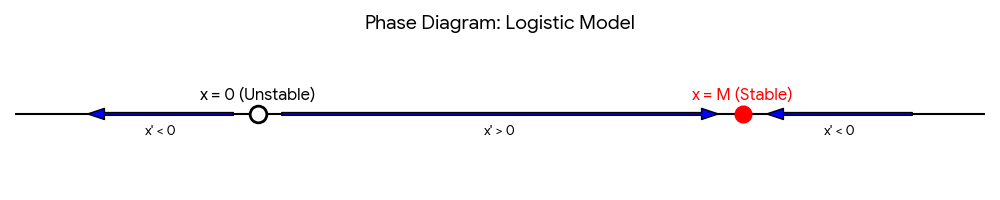
Graphically, every solution either approaches \(x \equiv M\) as \(t\) increases or diverges away from \(x \equiv 0\). Thus, \(M\) is a stable critical point and \(0\) is an unstable critical point.
Consider the explosion / extinction equation: $$\frac{dx}{dt} = kx(x - M)$$
Critical points: \(kx(x - M) = 0 \implies x = 0, M\).
Phase diagram analysis:
- If \(x > M\), then \(x' > 0\) (explosion).
- If \(0 < x < M\), then \(x' < 0\) (extinction).
- If \(x < 0\), then \(x' > 0\).
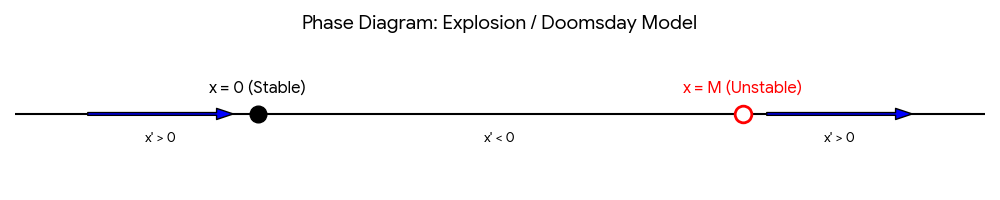
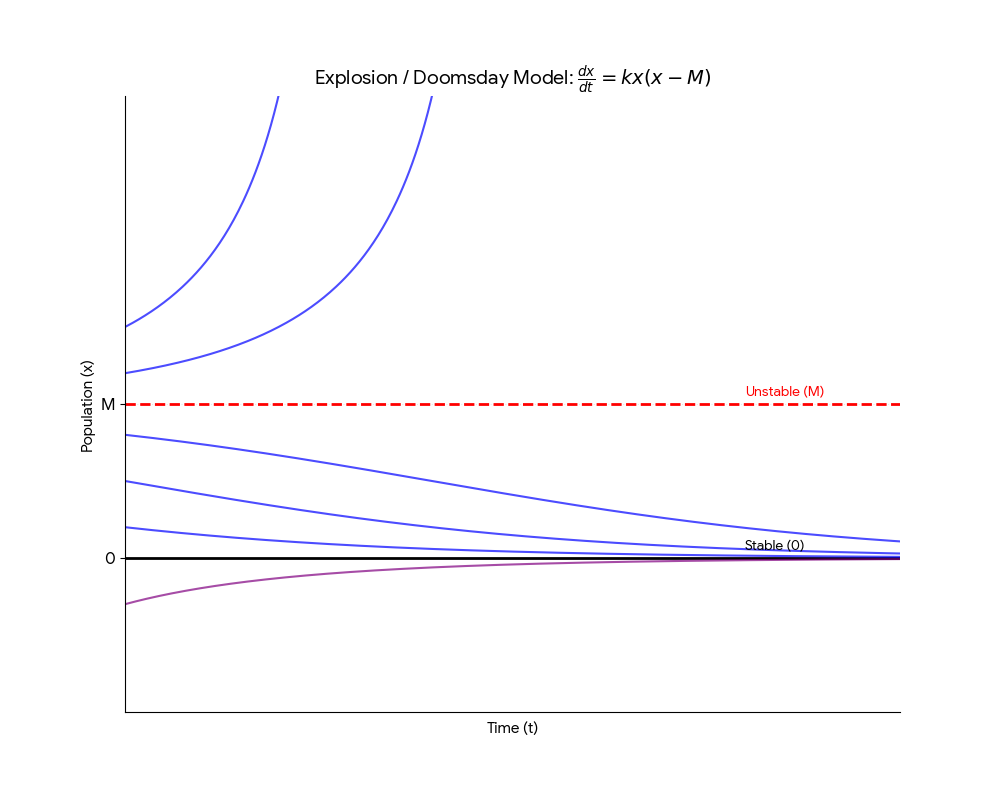
In this case, \(0\) is a stable equilibrium and \(M\) is an unstable equilibrium.
(III) Harvesting a Logistic Population
Consider the population of fish in a lake from which \(h\) fish per year are removed by fishing:
Suppose that \(k = 1, M = 4\) for a logistic population \(x(t)\) of fish in a lake, measured in hundreds after \(t\) years.
(a) Suppose harvesting level \(h = 3\) (300 fish are harvested annually):
Find all the critical points and equilibrium solutions. Check the stability.
$$\frac{dx}{dt} = x(4 - x) - 3 = -x^2 + 4x - 3 = -(x - 1)(x - 3) = 0$$
Critical points are \(x = 1\) and \(x = 3\). Stability check: \(x = 3\) is a stable equilibrium limiting solution and \(x = 1\) is an unstable threshold solution that separates different behavior.
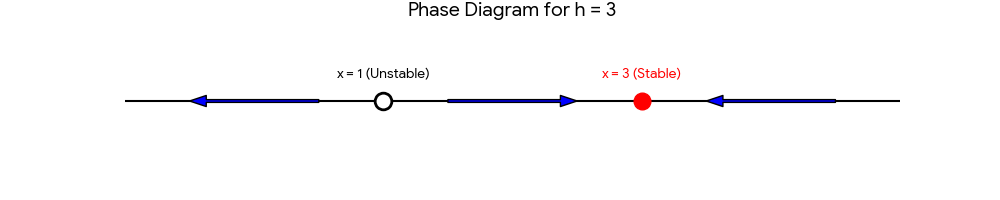
Phase diagram for h = 3: Arrows point toward the stable equilibrium at 3 and away from the unstable threshold at 1.
The population approaches 300 if the initial population \(x_0 > 1\). It becomes extinct because of harvesting if \(x_0 < 1\).
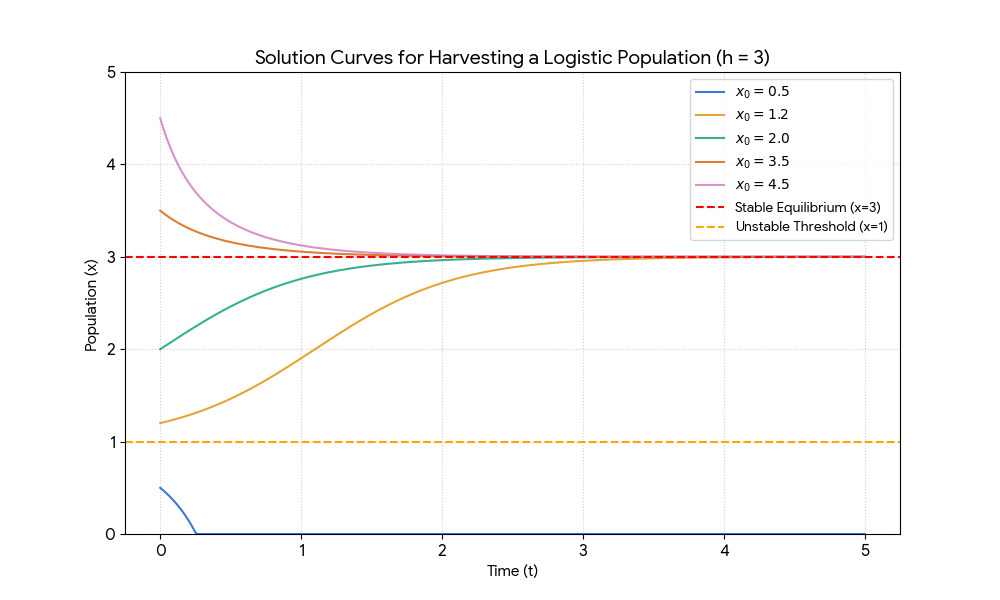
(b) Investigating the dependence of this picture upon the harvesting level \(h\):
$$\frac{dx}{dt} = x(4 - x) - h \implies -x^2 + 4x - h = 0$$
Critical points are \(c = \frac{1}{2}(4 \pm \sqrt{16 - 4h}) = 2 \pm \sqrt{4 - h}\).
- Case 1 (harvesting level \(h < 4\)): There are two distinct equilibrium solutions \(x(t) \equiv N\) and \(x(t) \equiv H\) with \(N > H\). This case is similar to Part (a).
-
Case 2 (harvesting level \(h = 4\)): \(N = H = 2\). There is only one equilibrium solution \(x(t) \equiv 2\), which is semistable.
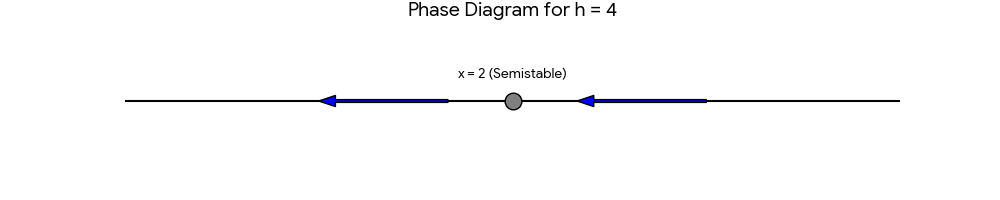
Phase diagram for h = 4: The equilibrium at x = 2 is semistable.
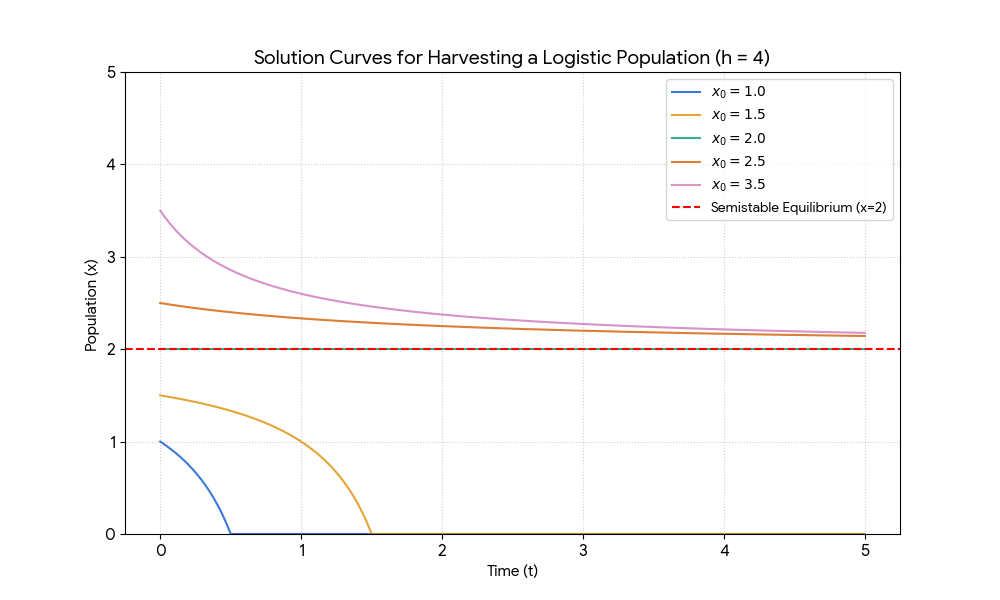
Solution Curves for h = 4 - Case 3 (harvesting level \(h > 4\)): There is no real solution and no equilibrium solution. The population dies out as a result of excessive harvesting.
The value \(h = 4\), for which the qualitative nature of the solutions changes as \(h\) increases, is called a bifurcation point for the differential equation containing parameter \(h\).
The bifurcation diagram consists of all points \((h, c)\) where \(c\) is a critical point of the equation \(x' = x(4 - x) - h\).
Since \(c = 2 \pm \sqrt{4 - h}\), we have \((c - 2)^2 = 4 - h\).
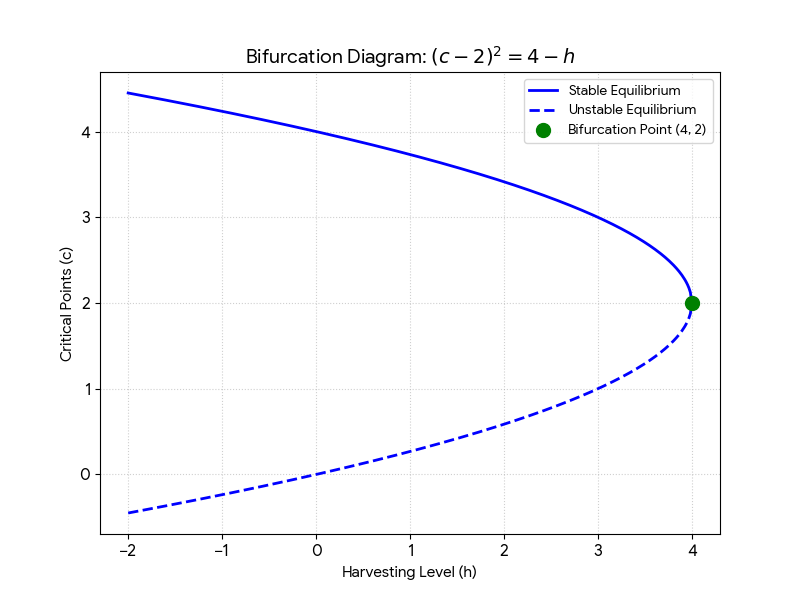
Bifurcation diagram: The parabola separates regions of two, one (semistable), or no equilibrium solutions based on h.