(I) Introduction
Consider a force \(f(t)\) that acts only during a very short time interval \(a \le t \le b\), with \(f(t) = 0\) outside the interval. For example, the impulsive force of a bat striking a ball — the impact is almost instantaneous.
In such a situation, it often happens that the principal effect of the force depends only on the value of the integral (the impulse of the force \(f(t)\) over \([a,b]\)):
The effect doesn't depend on how \(f(t)\) varies with time \(t\). Therefore, we don't need to know the precise function \(f(t)\), which is good since we're unlikely to have such detailed information.
Strategy
Our strategy is to set up a reasonable mathematical model in which the unknown force \(f(t)\) is replaced with a simple and explicit force that has the same impulse.
For simplicity, suppose that \(f(t)\) has an impulse \(p = 1\) and acts during some brief time beginning at \(t=a > 0\). We can select a fixed number \(\epsilon > 0\) that approximates the length of this time interval and replace \(f(t)\) with:
This function creates a rectangle with width \(\epsilon\) and height \(1/\epsilon\), resulting in an area of 1. In fact, for \(b \ge a + \epsilon\):
Thus, \(d_{a,\epsilon}\) has a unit impulse whatever \(\epsilon\) may be: \( \int_{0}^{\infty} d_{a,\epsilon}(t) \, dt = 1 \).
(II) Delta Function as an Operator
Because the precise time interval during which the force acts seems unimportant, it's tempting to think of an instantaneous impulse occurring precisely at \(t=a\).
Dirac Delta Function
We define the Dirac delta function as the limit of \(d_{a,\epsilon}(t)\) as \(\epsilon \to 0\):
This "function" has the following contradictory properties:
No actual function can satisfy both conditions, so \(\delta_a(t)\) is not a genuine function. But \(\delta_a(t)\) is highly useful as an operator.
If \(g(t)\) is a continuous function, then the mean value theorem for integrals implies that:
Applying this to the limit definition of the delta function:
This gives the fundamental sifting property of the delta function:
The delta function operates on a continuous function \(g(t)\) and "sifts out" its value at \(a\), \(g(a)\).
Laplace Transform of the Delta Function
Let \(g(t) = e^{-st}\). Applying the sifting property:
If \(\delta(t) = \delta_0(t)\) and \(\delta(t-a) = \delta_a(t)\), then \(\mathcal{L}\{\delta(t)\} = e^{0} = 1\).
(III) Delta Function Input
Suppose that we're given a mechanical system whose response \(x(t)\) to an external force \(f(t)\) is determined by:
To investigate the response of this system to a unit impulse at \(t=a\), it's reasonable to replace \(f(t)\) with \(\delta_a(t)\):
\(x(t)\) is a solution to this equation provided that \( x(t) = \lim_{\epsilon \to 0} x_\epsilon(t) \), where \(x_\epsilon(t)\) is a solution of \( Ax'' + Bx' + Cx = d_{a,\epsilon}(t) \).
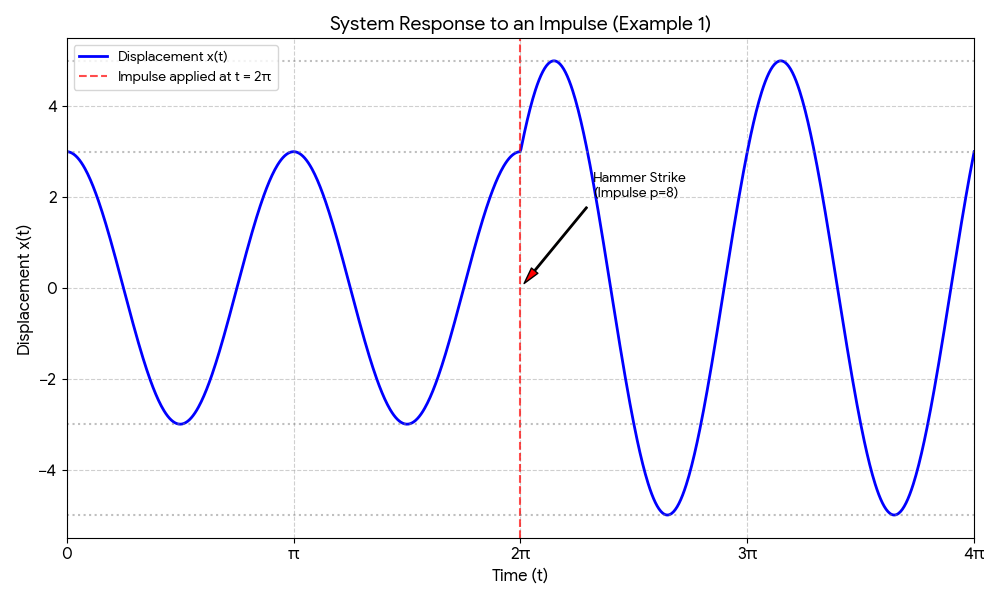
Solve the Initial Value Problem: A mass \(m=1\) is attached to a spring with \(k=4\) and no dashpot. The mass is released from rest with \(x(0)=3\). At the instant \(t=2\pi\), the mass is struck with a hammer providing an impulse \(p=8\). Determine the motion of the mass.
Solution: Set up the differential equation with the impulse modeled as a delta function:
Take the Laplace transform:
Take the inverse Laplace transform. Remember that \(e^{-2\pi s}\) translates the function by \(2\pi\) and multiplies by the unit step function \(u_{2\pi}(t)\):
For \(t > 2\pi\), \(x(t) = 3\cos(2t) + 4\sin(2t)\). This can be written as \(R\cos(2t-\alpha)\) where \(R = \sqrt{3^2 + 4^2} = 5\) and \(\alpha = \tan^{-1}(4/3) \approx 0.9273\).
(IV) System Analysis and Duhamel's Principle
Consider a system in which the response \(x(t)\) to the input function \(f(t)\) satisfies:
Taking the Laplace transform:
Where \(W(s) = \frac{1}{as^2 + bs + c}\) is the transfer function of the system, and \(w(t) = \mathcal{L}^{-1}\{W(s)\}\) is the weight function.
Duhamel's Principle
By the convolution property, the solution is:
The weight function \(w(t)\) is completely determined by the parameters of the system.
Solve the Initial Value Problem: \( x'' + 6x' + 10x = f(t), \quad x(0) = x'(0) = 0 \).
Solution: Find the transfer function and the weight function.
Complete the square to find \(w(t)\):
Using Duhamel's Principle:
Solve \( x'' + 2x' + x = \delta(t) - \delta(t-2); \quad x(0) = x'(0) = 2 \).
Solution: Take the Laplace transform:
Split the fraction to prepare for inverse transformation:
Take the inverse transform, applying translation for the \(e^{-2s}\) term: