Introduction
In Section 1.4, we introduced the exponential differential equation: \(\frac{dP}{dt} = kP\) with \(P(t) = P_0 e^{kt}\)
This serves as a mathematical model for natural population growth resulting from a constant birth rate \(\beta\) and a constant death rate \(\delta\), where \(k = \beta - \delta\) and \(P_0 = P(0)\).
Suppose that the population changes only by the occurrence of births and deaths (no immigration, etc.). We consider \(P(t)\) as a continuous approximation to the actual population. The general population equation is:
$$\frac{dP}{dt} = (\beta(t) - \delta(t))P$$
(I) Bounded Population and the Logistic Equation
It is often observed that the birth rate decreases as the population itself increases. For example, let \(\beta = \beta_0 - \beta_1 P\) (a decreasing function of \(P\)) while the death rate \(\delta = \delta_0\) remains constant.
where \(a = \beta_0 - \delta_0\) and \(b = \beta_1 > 0\). This is called the Logistic Equation if \(a > 0, b > 0\).
To relate the behavior of \(P(t)\) to the value of parameters, we rewrite it as:
where \(k = b > 0\) and \(M = a/b\) are constants.
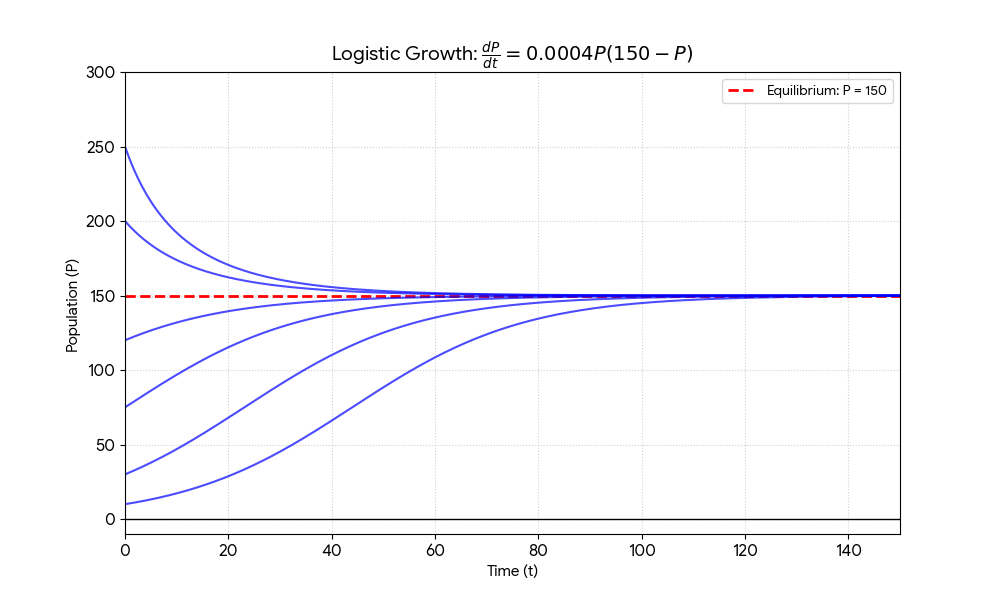
Consider the equation: $$\frac{dP}{dt} = 0.0004P(150 - P), \quad P(0) = P_0$$
1. Separate the variables and integrate:
$$\int \frac{dP}{P(150 - P)} = \int 0.0004 \, dt$$
2. Use partial fraction decomposition:
Note that \( \frac{1}{P(150 - P)} = \frac{1/150}{P} + \frac{1/150}{150 - P} \). Multiplying the equation by 150 gives:
$$\int \left( \frac{1}{P} + \frac{1}{150 - P} \right) dP = \int (150 \times 0.0004) \, dt$$
$$\int \left( \frac{1}{P} + \frac{1}{150 - P} \right) dP = \int 0.06 \, dt$$
3. Perform the integration:
$$\ln|P| - \ln|150 - P| = 0.06t + C_1$$
$$\ln \left| \frac{P}{150 - P} \right| = 0.06t + C_1$$
4. Solve for the ratio:
$$\frac{P}{150 - P} = e^{0.06t + C_1} = C e^{0.06t}$$
5. Apply initial condition \( P(0) = P_0 \) to find \( C \):
$$\frac{P_0}{150 - P_0} = C e^{0} \implies C = \frac{P_0}{150 - P_0}$$
6. Final particular solution for \( P(t) \):
$$\frac{P}{150 - P} = \frac{P_0}{150 - P_0} e^{0.06t}$$
After algebraic rearrangement:
$$P(t) = \frac{150 P_0}{P_0 + (150 - P_0)e^{-0.06t}}$$
7. Equilibrium analysis:
$$\lim_{t \to \infty} P(t) = 150$$
When \( P = 150 \), \( \frac{dP}{dt} = 0 \), so \( P \equiv 150 \) is an equilibrium solution. All solution curves approach this line as an asymptote.
(II) Limiting Population and Carrying Capacity
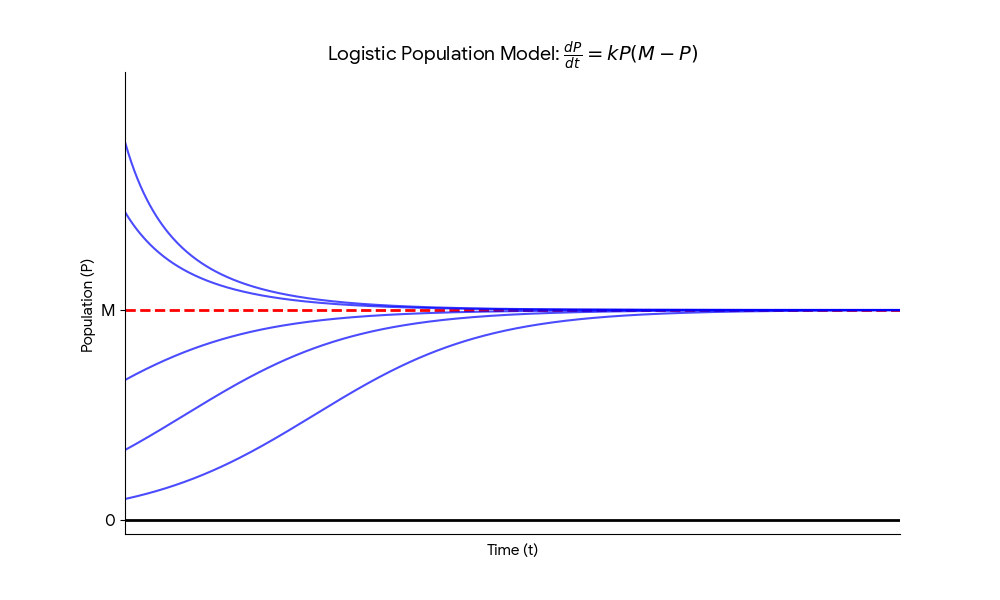
The solution to the logistic equation \(\frac{dP}{dt} = kP(M-P)\) with \(P(0) = P_0\) is given by:
\(P(t) \equiv M\) is called the equilibrium population. We analyze the behavior based on the initial population \(P_0\):
- If \(P_0 > M\): Then \(P' < 0\). In this case, \(M - P_0\) is a negative number, which leads to: \(P(t) = \frac{M P_0}{P_0 + (\text{neg. number})} > \frac{M P_0}{P_0} = M\) The population decreases steadily and approaches \(M\) from above.
- If \(0 < P_0 < M\): Then \(P' > 0\). The population increases steadily and approaches \(M\) from below.
In any case, the population eventually stabilizes:
\(M\) is defined as the limiting population or carrying capacity.
Consider a population \( P(t) \) satisfying the logistic equation: $$\frac{dP}{dt} = aP - bP^2, \quad P(0) = P_0$$
- \( B = aP \) is the time rate at which births occur.
- \( B_0 = aP_0 \) is the birth rate at \( t = 0 \).
- \( D = bP^2 \) is the time rate at which deaths occur.
- \( D_0 = bP_0^2 \) is the death rate at \( t = 0 \).
Problem: If the initial population is 120 rabbits and there are 8 births per month and 6 deaths per month occurring at time \( t = 0 \), how many months does it take for \( P(t) \) to reach 95% of the limiting population \( M \)?
1. Find the Limiting Population (M): $$M = \frac{a}{b} = \frac{B_0 / P_0}{D_0 / P_0^2} = \frac{B_0 P_0}{D_0}$$ Using the given values: $$M = \frac{8 \times 120}{6} = 160$$
2. Determine the constant \( k \): $$k = \frac{b}{120} = \frac{D_0 / P_0^2}{120} \text{ (from } b = \frac{D_0}{P_0^2} \text{)}$$ $$k = \frac{6}{120^2} = \frac{1}{2400}$$
3. Calculate the time \( t \): Using the logistic solution formula: $$P(t) = \frac{M P_0}{P_0 + (M - P_0)e^{-kMt}} = 0.95M$$ Substituting \( P_0 = 120, M = 160 \), and \( kM = \frac{160}{2400} = \frac{1}{15} \): $$\frac{120M}{120 + (160 - 120)e^{-\frac{1}{15}t}} = 0.95M$$
Result: $$t \approx 27.69 \text{ months}$$
(III) Doomsday Versus Extinction
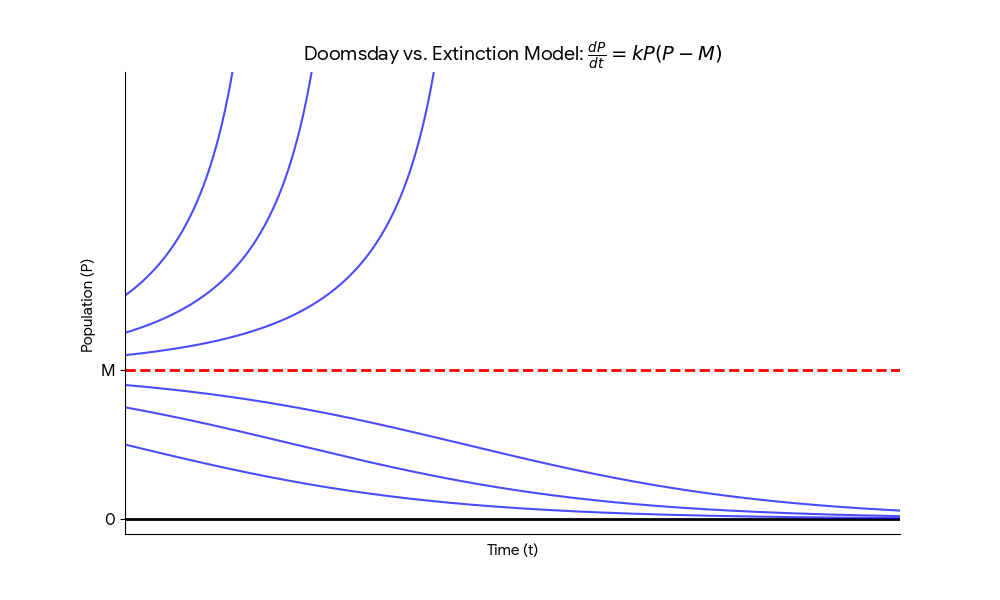
Consider animals that rely on chance encounters for reproduction. Encounters occur at a rate proportional to \(P/2 \times P/2\), hence proportional to \(P^2\).
- If \(P_0 > M\): \(P' > 0\), leads to a population explosion.
- If \(P_0 < M\): \(P' < 0\), leads to population extinction.
\(M\) is called the threshold population. The outcome depends critically on whether \(P_0\) is above or below \(M\).
Extra Example: Rumor Spreading
Suppose half of a logistic population of 100,000 have heard a rumor at \(t=0\). The number of those who heard it is increasing at a rate of 1000 per day. How long to spread to 80%?
Setup: \(M = 100,000\), \(P(0) = 50,000\), \(P'(0) = 1000\).
\(P' = kP(M - P) \implies 1000 = k(50,000)(100,000 - 50,000) \implies k = \frac{1}{2,500,000}\).
Solve for \(P(t) = 0.8M = 80,000\):
$$\frac{100,000}{1 + e^{-0.04t}} = 80,000 \implies \frac{1}{1 + e^{-0.04t}} = 0.8 \implies t \approx 34.66 \text{ days.}$$