Definition
A transformation / function / mapping \(T\) from \(\mathbb{R}^n\) to \(\mathbb{R}^m\) is a rule that assigns to each vector \(\vec{x}\) in \(\mathbb{R}^n\) a vector \(T(\vec{x})\) in \(\mathbb{R}^m\).
- \(\mathbb{R}^n\) is the Domain.
- \(\mathbb{R}^m\) is the Codomain.
- \(T(\vec{x})\): The image of \(\vec{x}\) under the action of \(T\).
- Range: The set of all images \(T(\vec{x})\).
We consider a transformation that acts on a vector \(\vec{x}\) by multiplication to produce a new vector called \(A\vec{x}\).
Recall: multiplication by \(A\)
\[ A\vec{x} = \begin{bmatrix} 4 & -3 & 1 \\ 2 & 0 & 5 \end{bmatrix} \begin{bmatrix} 1 \\ 1 \\ 1 \end{bmatrix} = \begin{bmatrix} 2 \\ 7 \end{bmatrix} \] \[ A = \begin{bmatrix} \vec{a}_1 & \dots & \vec{a}_n \end{bmatrix}, \quad \vec{x} = \begin{bmatrix} x_1 \\ \vdots \\ x_n \end{bmatrix} \] \[ A\vec{x} = x_1\vec{a}_1 + \dots + x_n\vec{a}_n \](I) Matrix Transformation
\[ T : \mathbb{R}^n \rightarrow \mathbb{R}^m \] \[ \vec{x} \mapsto A\vec{x} \] \[ T(\vec{x}) = A\vec{x} \]Where \(A\) is an \(m \times n\) matrix: \(A = \begin{bmatrix} \vec{a}_1 & \dots & \vec{a}_n \end{bmatrix}\).
Range of \(T\)
This equals the set of all linear combinations of the columns of \(A\).
Let \(A = \begin{bmatrix} 1 & -3 \\ 3 & 5 \\ -1 & 7 \end{bmatrix}\), \(\vec{u} = \begin{bmatrix} 2 \\ -1 \end{bmatrix}\), \(\vec{b} = \begin{bmatrix} 3 \\ 2 \\ -5 \end{bmatrix}\), and \(\vec{c} = \begin{bmatrix} 3 \\ 2 \\ 5 \end{bmatrix}\).
Define a transformation \(T: \mathbb{R}^2 \rightarrow \mathbb{R}^3\) by \(T(\vec{x}) = A\vec{x}\).
(1) Find \(T(\vec{u})\), the image of \(\vec{u}\) under \(T\).
\[ T(\vec{u}) = A\vec{u} = \begin{bmatrix} 1 & -3 \\ 3 & 5 \\ -1 & 7 \end{bmatrix} \begin{bmatrix} 2 \\ -1 \end{bmatrix} = \begin{bmatrix} 5 \\ 1 \\ -9 \end{bmatrix} \](2) Find an \(\vec{x}\) in \(\mathbb{R}^2\) whose image under \(T\) is \(\vec{b}\). That is, solve \(A\vec{x} = \vec{b}\). (Existence Question)
\[ \begin{bmatrix} 1 & -3 & 3 \\ 3 & 5 & 2 \\ -1 & 7 & -5 \end{bmatrix} \rightarrow \begin{bmatrix} 1 & -3 & 3 \\ 0 & 14 & -7 \\ 0 & 4 & -2 \end{bmatrix} \rightarrow \begin{bmatrix} 1 & -3 & 3 \\ 0 & 2 & -1 \\ 0 & 0 & 0 \end{bmatrix} \rightarrow \begin{bmatrix} 1 & 0 & 1.5 \\ 0 & 1 & -0.5 \\ 0 & 0 & 0 \end{bmatrix} \] \[ \begin{cases} x_1 = 1.5 \\ x_2 = -0.5 \end{cases} \implies \vec{x} = \begin{bmatrix} 1.5 \\ -0.5 \end{bmatrix} \](3) Is there more than one \(\vec{x}\) whose image under \(T\) is \(\vec{b}\)? (Uniqueness Question)
Since the system in part (2) has a unique solution, there is exactly one \(\vec{x}\) whose image is \(\vec{b}\).
(4) Determine if \(\vec{c}\) is in the range of \(T\).
Check if \(A\vec{x} = \vec{c}\) is consistent. (Existence Question)
\[ \begin{bmatrix} 1 & -3 & 3 \\ 3 & 5 & 2 \\ -1 & 7 & 5 \end{bmatrix} \rightarrow \begin{bmatrix} 1 & -3 & 3 \\ 0 & 14 & -7 \\ 0 & 4 & 8 \end{bmatrix} \rightarrow \begin{bmatrix} 1 & -3 & 3 \\ 0 & 1 & -0.5 \\ 0 & 0 & 10 \end{bmatrix} \]The system is inconsistent. Therefore, \(\vec{c}\) is not in the range of \(T\).
(II) Linear Transformations
Definition
A transformation \(T\) is linear if:
- \(T(\vec{u} + \vec{v}) = T(\vec{u}) + T(\vec{v})\) for all \(\vec{u}\) and \(\vec{v}\) in the domain.
- \(T(c\vec{u}) = cT(\vec{u})\) for all scalars \(c\) and all \(\vec{u}\) in the domain of \(T\).
A linear transformation preserves the operations of vector addition and scalar multiplication.
Recall Theorem 5 in Section 1.4: Properties of the Matrix-Vector Product \(A\vec{x}\)
If \(A\) is an \(m \times n\) matrix, \(\vec{u}\) and \(\vec{v}\) are vectors in \(\mathbb{R}^n\), and \(c\) is a scalar, then:
- \(A(\vec{u} + \vec{v}) = A\vec{u} + A\vec{v}\)
- \(A(c\vec{u}) = c(A\vec{u})\)
Every matrix transformation is linear, but not all linear transformations are matrix transformations.
Facts
If \(T\) is a linear transformation, then:
- \(T(\vec{0}) = \vec{0}\) (Check this first!)
- \(T(c\vec{u} + d\vec{v}) = cT(\vec{u}) + dT(\vec{v})\)
Repeated application of (2) produces a useful generalization:
Proof of Fact 1 & 2:
If \(T\) is linear:
\[ T(0 \cdot \vec{u}) = 0T(\vec{u}) \implies T(\vec{0}) = \vec{0} \] \[ T(c\vec{u} + d\vec{v}) = T(c\vec{u}) + T(d\vec{v}) \quad \text{(T preserves vector addition)} \] \[ = cT(\vec{u}) + dT(\vec{v}) \quad \text{(T preserves scalar multiplication)} \]- If \(c = d = 1\), then \(T(\vec{u} + \vec{v}) = T(\vec{u}) + T(\vec{v})\).
- If \(d = 0\), then \(T(c\vec{u} + 0 \cdot \vec{v}) = cT(\vec{u}) + 0T(\vec{v}) = cT(\vec{u})\).
Some matrix transformations can be viewed geometrically.
Let \(A = \begin{bmatrix} 0 & -1 \\ -1 & 0 \end{bmatrix}\). Find the images of \(\begin{bmatrix} 1 \\ 0 \end{bmatrix}\) and \(\begin{bmatrix} 0 \\ 1 \end{bmatrix}\) under the action of the matrix transformation \(T: \vec{x} \mapsto A\vec{x}\).
\[ T\left(\begin{bmatrix} 1 \\ 0 \end{bmatrix}\right) = \begin{bmatrix} 0 & -1 \\ -1 & 0 \end{bmatrix} \begin{bmatrix} 1 \\ 0 \end{bmatrix} = \begin{bmatrix} 0 \\ -1 \end{bmatrix} \] \[ T\left(\begin{bmatrix} 0 \\ 1 \end{bmatrix}\right) = \begin{bmatrix} 0 & -1 \\ -1 & 0 \end{bmatrix} \begin{bmatrix} 0 \\ 1 \end{bmatrix} = \begin{bmatrix} -1 \\ 0 \end{bmatrix} \]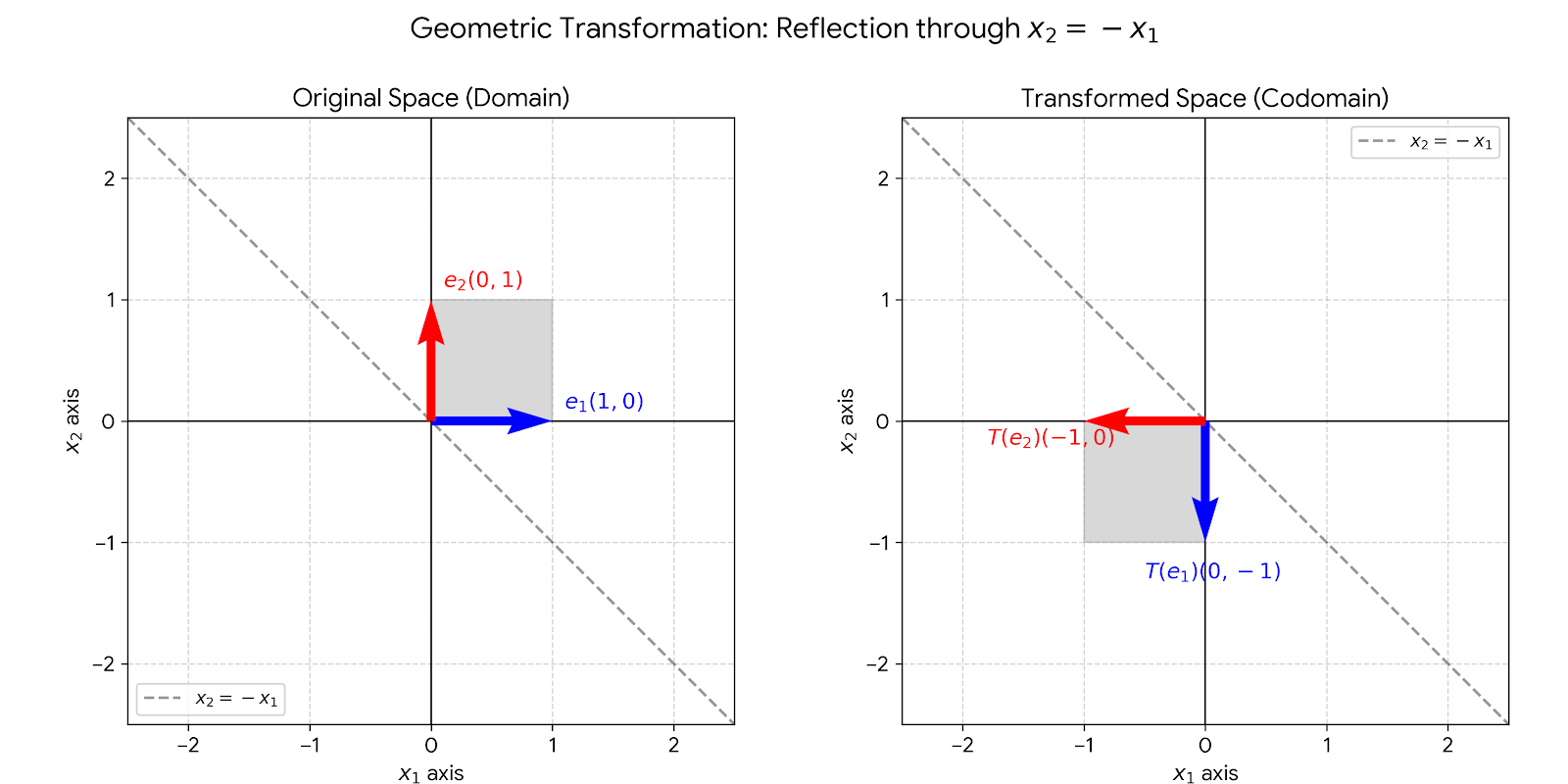
Show that the dilation transformation \(T: \mathbb{R}^2 \rightarrow \mathbb{R}^2\) defined by \(T: \vec{x} \mapsto 3\vec{x}\) is a linear transformation.
Proof:
\( T(\vec{0}) = 3 \cdot \vec{0} = \vec{0} \)For any \(\vec{u}, \vec{v}\) in \(\mathbb{R}^2\) and scalars \(c, d\):
\( T(c\vec{u} + d\vec{v}) = 3(c\vec{u} + d\vec{v}) = 3c\vec{u} + 3d\vec{v} = c(3\vec{u}) + d(3\vec{v}) = cT(\vec{u}) + dT(\vec{v}) \)Therefore, \(T\) is a linear transformation.
Let \(\vec{e}_1 = \begin{bmatrix} 1 \\ 0 \end{bmatrix}\), \(\vec{e}_2 = \begin{bmatrix} 0 \\ 1 \end{bmatrix}\), \(\vec{y}_1 = \begin{bmatrix} 2 \\ 5 \end{bmatrix}\), and \(\vec{y}_2 = \begin{bmatrix} -1 \\ 6 \end{bmatrix}\).
Let \(T: \mathbb{R}^2 \rightarrow \mathbb{R}^2\) be a linear transformation that maps \(\vec{e}_1\) to \(\vec{y}_1\) and \(\vec{e}_2\) to \(\vec{y}_2\).
(1) Find the images of \(\begin{bmatrix} 5 \\ -3 \end{bmatrix}\) and \(\begin{bmatrix} x_1 \\ x_2 \end{bmatrix}\).
Solution: Notice that \(\begin{bmatrix} 5 \\ -3 \end{bmatrix} = 5\begin{bmatrix} 1 \\ 0 \end{bmatrix} - 3\begin{bmatrix} 0 \\ 1 \end{bmatrix} = 5\vec{e}_1 - 3\vec{e}_2\).
Since \(T\) is linear,
\(T\left(\begin{bmatrix} 5 \\ -3 \end{bmatrix}\right) = 5T(\vec{e}_1) - 3T(\vec{e}_2) = 5\vec{y}_1 - 3\vec{y}_2= 5\begin{bmatrix} 2 \\ 5 \end{bmatrix} - 3\begin{bmatrix} -1 \\ 6 \end{bmatrix} = \begin{bmatrix} 10 \\ 25 \end{bmatrix} + \begin{bmatrix} 3 \\ -18 \end{bmatrix} = \begin{bmatrix} 13 \\ 7 \end{bmatrix} \)For the general vector \(\begin{bmatrix} x_1 \\ x_2 \end{bmatrix}\),
\(T\left(\begin{bmatrix} x_1 \\ x_2 \end{bmatrix}\right) = T(x_1\vec{e}_1 + x_2\vec{e}_2)= x_1T(\vec{e}_1) + x_2T(\vec{e}_2) \quad \text{(Since T is linear)}\)
\(\qquad \qquad \ \ = x_1\vec{y}_1 + x_2\vec{y}_2 = x_1\begin{bmatrix} 2 \\ 5 \end{bmatrix} + x_2\begin{bmatrix} -1 \\ 6 \end{bmatrix} = \begin{bmatrix} 2x_1 - x_2 \\ 5x_1 + 6x_2 \end{bmatrix} \)(2) Find a matrix \(A\) such that \(T(\vec{x})\) is \(A\vec{x}\) for all \(\vec{x}\).
\( \begin{bmatrix} 2x_1 - x_2 \\ 5x_1 + 6x_2 \end{bmatrix} = \begin{bmatrix} 2 & -1 \\ 5 & 6 \end{bmatrix} \begin{bmatrix} x_1 \\ x_2 \end{bmatrix} \)Therefore, \(A = \begin{bmatrix} 2 & -1 \\ 5 & 6 \end{bmatrix}\).