(I) The Matrix of a Linear Transformation
Recall:
For \(T: \mathbb{R}^n \rightarrow \mathbb{R}^m\) where \(\vec{x} \mapsto A\vec{x}\), \(A\) is an \(m \times n\) matrix.
Actually, every linear transformation from \(\mathbb{R}^n\) to \(\mathbb{R}^m\) is a matrix transformation, and therefore important properties of \(T\) are intimately related to familiar properties of \(A\). The key is that \(T\) is completely determined by what it does to the columns of the identity matrix \(I_n = \begin{bmatrix} \vec{e}_1 & \dots & \vec{e}_n \end{bmatrix}\).
Suppose \(T\) is a linear transformation from \(\mathbb{R}^2\) to \(\mathbb{R}^3\) such that \(T(\vec{e}_1)= \begin{bmatrix} 5 \\ -7 \\ 2 \end{bmatrix}\) and \(T(\vec{e}_2) = \begin{bmatrix} -3 \\ 8 \\ 0 \end{bmatrix}\).
Find a formula for the image of an arbitrary \(\vec{x}\) in \(\mathbb{R}^2\).
Solution:
First, write \(\vec{x}\) as a linear combination of the standard basis vectors:
\[ \vec{x} = \begin{bmatrix} x_1 \\ x_2 \end{bmatrix} = x_1 \begin{bmatrix} 1 \\ 0 \end{bmatrix} + x_2 \begin{bmatrix} 0 \\ 1 \end{bmatrix} = x_1\vec{e}_1 + x_2\vec{e}_2 \]Apply the transformation \(T\). Since \(T\) is linear:
\[ T(\vec{x}) = T(x_1\vec{e}_1 + x_2\vec{e}_2) = x_1T(\vec{e}_1) + x_2T(\vec{e}_2) \]Substitute the given images and format it as a matrix-vector product:
\[ = \begin{bmatrix} T(\vec{e}_1) & T(\vec{e}_2) \end{bmatrix} \begin{bmatrix} x_1 \\ x_2 \end{bmatrix} = x_1 \begin{bmatrix} 5 \\ -7 \\ 2 \end{bmatrix} + x_2 \begin{bmatrix} -3 \\ 8 \\ 0 \end{bmatrix} = \begin{bmatrix} 5x_1 - 3x_2 \\ -7x_1 + 8x_2 \\ 2x_1 \end{bmatrix} \]Notice that \(T\) is determined by what it does to \(I_2 = \begin{bmatrix} \vec{e}_1 & \vec{e}_2 \end{bmatrix}\).
Theorem 10
Let \(T: \mathbb{R}^n \rightarrow \mathbb{R}^m\) be a linear transformation. Then there exists a unique matrix \(A\) such that \(T(\vec{x}) = A\vec{x}\) for all \(\vec{x}\) in \(\mathbb{R}^n\).
Proof of "Existence":
\[ \vec{x} = \begin{bmatrix} x_1 \\ \vdots \\ x_n \end{bmatrix} = x_1\vec{e}_1 + \dots + x_n\vec{e}_n \] \[ T(\vec{x}) = T(x_1\vec{e}_1 + \dots + x_n\vec{e}_n) = x_1T(\vec{e}_1) + \dots + x_nT(\vec{e}_n) \]Standard Matrix of a Linear Transformation
The unique matrix \(A\) that represents the linear transformation \(T\) is called the Standard Matrix for \(T\) and is given by the formula:
Every linear transformation from \(\mathbb{R}^n \rightarrow \mathbb{R}^m\) can be viewed as a matrix transformation and vice versa.
Let \(T: \mathbb{R}^2 \rightarrow \mathbb{R}^2\) be the transformation that rotates each point in \(\mathbb{R}^2\) about the origin through an angle \(\varphi\) (with counterclockwise rotation for a positive angle). Find the standard matrix \(A\).
Solution:
Under a rotation of \(\varphi\), the standard basis vector \(\vec{e}_1 = (1, 0)\) rotates to \((\cos\varphi, \sin\varphi)\). The basis vector \(\vec{e}_2 = (0, 1)\) rotates to \((-\sin\varphi, \cos\varphi)\).
\[ A = \begin{bmatrix} \cos\varphi & -\sin\varphi \\ \sin\varphi & \cos\varphi \end{bmatrix} \]If \(\varphi = \frac{\pi}{3}\):
\[ A = \begin{bmatrix} \frac{1}{2} & -\frac{\sqrt{3}}{2} \\ \frac{\sqrt{3}}{2} & \frac{1}{2} \end{bmatrix} \](More geometric linear transformations of \(\mathbb{R}^2\) can be found in the textbook P78-P80, Tables 1-4).
(II) Existence and Uniqueness Questions (Important)
Definition (Onto)
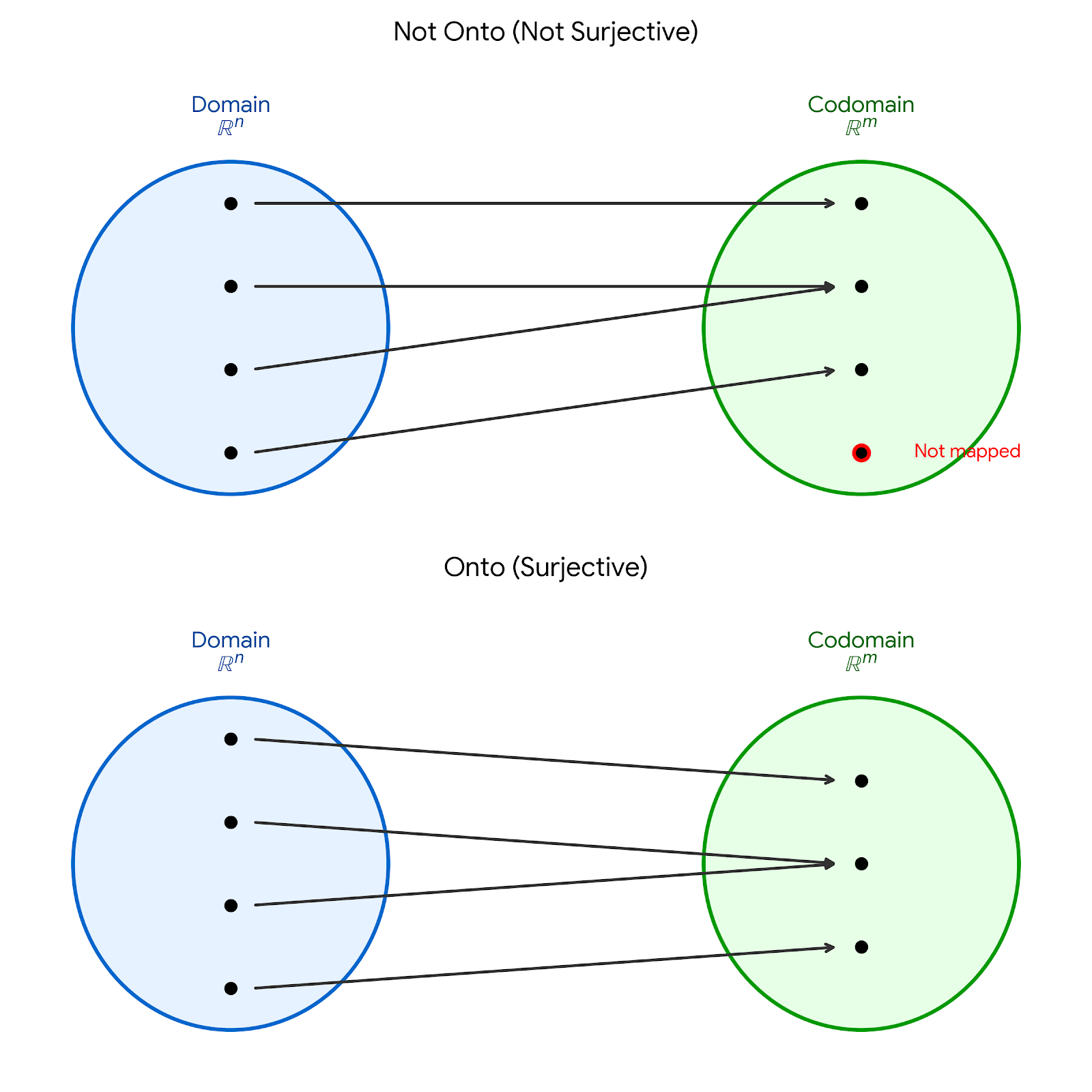
A mapping \(T: \mathbb{R}^n \rightarrow \mathbb{R}^m\) is said to be onto \(\mathbb{R}^m\) if every \(\vec{b}\) in \(\mathbb{R}^m\) is the image of at least one \(\vec{x}\) in \(\mathbb{R}^n\).
Equivalently, \(T\) is onto \(\mathbb{R}^m\) when the range of \(T\) is \(\mathbb{R}^m\).
Existence Question: For each \(\vec{b}\) in \(\mathbb{R}^m\), does there exist at least one \(\vec{x}\) in \(\mathbb{R}^n\) such that \(T(\vec{x}) = \vec{b}\)?
Definition (One-to-One)
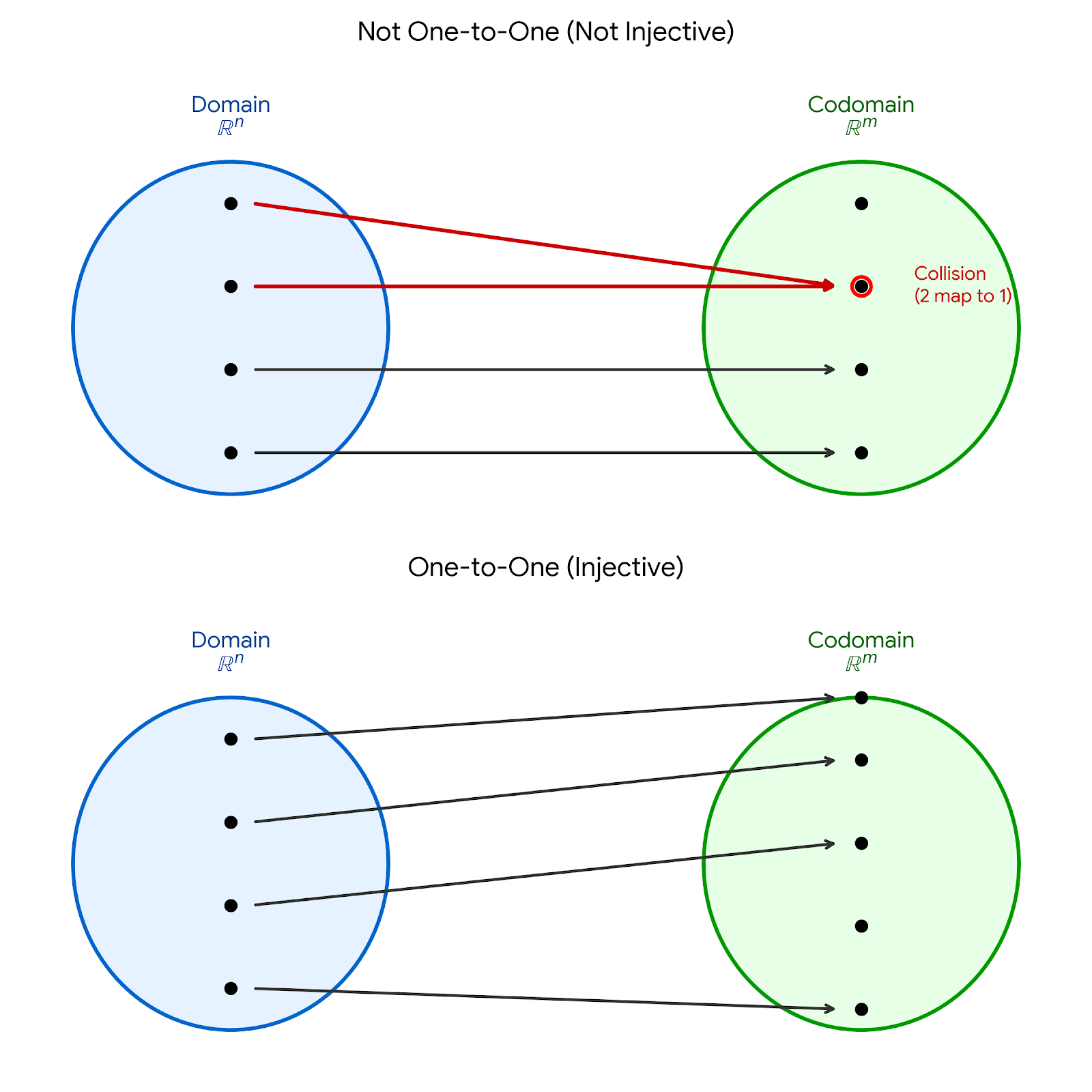
A mapping \(T: \mathbb{R}^n \rightarrow \mathbb{R}^m\) is said to be one-to-one if each \(\vec{b}\) in \(\mathbb{R}^m\) is the image of at most one \(\vec{x}\) in \(\mathbb{R}^n\).
Uniqueness Question: \(T\) is one-to-one if for each \(\vec{b}\) in \(\mathbb{R}^m\), \(T(\vec{x}) = \vec{b}\) has either a unique solution or none at all.
Theorem 11
Let \(T: \mathbb{R}^n \rightarrow \mathbb{R}^m\) be a linear transformation. \(T\) is one-to-one if and only if the equation \(T(\vec{x}) = \vec{0}\) has only the trivial solution.
(Proof skipped. Try it on your own.)
Let \(T\) be the linear transformation whose standard matrix is:
\[ A = \begin{bmatrix} 1 & -4 & 8 & 1 \\ 0 & 2 & -1 & 3 \\ 0 & 0 & 0 & 5 \end{bmatrix} \](Note: Pivots are located in column 1, column 2, and column 4).
(1) \(T\) maps from \(\mathbb{R}^n \rightarrow \mathbb{R}^m\). What are \(m\) and \(n\)?
Solution: \(n = 4\) (domain), \(m = 3\) (codomain).
(2) Is \(T\) a one-to-one transformation?
Solution: \(T\) is not one-to-one. Since the 3rd column is not a pivot column, \(x_3\) is a free variable. This means \(A\vec{x} = \vec{0}\) has non-trivial solutions.
(3) Does \(T\) map onto \(\mathbb{R}^3\)?
Solution: \(T\) maps onto \(\mathbb{R}^3\) since there is a pivot position in every row, and hence the columns of \(A\) span \(\mathbb{R}^3\).
Theorem 12
Let \(T: \mathbb{R}^n \rightarrow \mathbb{R}^m\) be a linear transformation, and let \(A\) be the standard matrix for \(T\). Then:
-
\(T\) maps \(\mathbb{R}^n\) onto \(\mathbb{R}^m\)
- \(\iff\) the columns of \(A\) span \(\mathbb{R}^m\)
- \(\iff\) each row of \(A\) has a pivot position (by Theorem 4).
-
\(T\) is one-to-one
- \(\iff\) the equation \(A\vec{x} = \vec{0}\) has only the trivial solution (by Theorem 11)
- \(\iff\) the columns of \(A\) are linearly independent (Proposition in Section 1.7)
- \(\iff\) each column of \(A\) is a pivot column.
Proof of (a):
By Theorem 4, the columns of \(A\) span \(\mathbb{R}^m\) if and only if for each \(\vec{b}\) in \(\mathbb{R}^m\), \(A\vec{x} = \vec{b}\) (or \(T(\vec{x}) = \vec{b}\)) has at least one solution. This is the exact definition of \(T\) being onto \(\mathbb{R}^m\). Furthermore, this is true if and only if each row of \(A\) has a pivot position.
Proof of (b):
\(T\) is one-to-one if and only if \(A\vec{x} = \vec{0}\) has only the trivial solution (Theorem 11). This is true if and only if the columns of \(A\) are linearly independent (Proposition in Section 1.7), which happens if and only if each column of \(A\) is a pivot column.
Let \(T: \mathbb{R}^2 \rightarrow \mathbb{R}^2\) be the linear transformation for which \(T\left(\begin{bmatrix} 1 \\ 1 \end{bmatrix}\right) = \begin{bmatrix} 3 \\ 4 \end{bmatrix}\) and \(T\left(\begin{bmatrix} -1 \\ 1 \end{bmatrix}\right) = \begin{bmatrix} -1 \\ -2 \end{bmatrix}\).
Find the standard matrix of \(T\).
Solution:
Note that \(A = \begin{bmatrix} T\left(\begin{bmatrix} 1 \\ 0 \end{bmatrix}\right) & T\left(\begin{bmatrix} 0 \\ 1 \end{bmatrix}\right) \end{bmatrix}\). We must express \(\vec{e}_1\) and \(\vec{e}_2\) using the given vectors.
\[ \begin{bmatrix} 1 \\ 0 \end{bmatrix} = \frac{1}{2}\begin{bmatrix} 1 \\ 1 \end{bmatrix} - \frac{1}{2}\begin{bmatrix} -1 \\ 1 \end{bmatrix} \] \[ T\left(\begin{bmatrix} 1 \\ 0 \end{bmatrix}\right) = \frac{1}{2}T\left(\begin{bmatrix} 1 \\ 1 \end{bmatrix}\right) - \frac{1}{2}T\left(\begin{bmatrix} -1 \\ 1 \end{bmatrix}\right) = \frac{1}{2}\begin{bmatrix} 3 \\ 4 \end{bmatrix} - \frac{1}{2}\begin{bmatrix} -1 \\ -2 \end{bmatrix} = \begin{bmatrix} 2 \\ 3 \end{bmatrix} \] \[ \begin{bmatrix} 0 \\ 1 \end{bmatrix} = \frac{1}{2}\begin{bmatrix} 1 \\ 1 \end{bmatrix} + \frac{1}{2}\begin{bmatrix} -1 \\ 1 \end{bmatrix} \] \[ T\left(\begin{bmatrix} 0 \\ 1 \end{bmatrix}\right) = \frac{1}{2}T\left(\begin{bmatrix} 1 \\ 1 \end{bmatrix}\right) + \frac{1}{2}T\left(\begin{bmatrix} -1 \\ 1 \end{bmatrix}\right) = \frac{1}{2}\begin{bmatrix} 3 \\ 4 \end{bmatrix} + \frac{1}{2}\begin{bmatrix} -1 \\ -2 \end{bmatrix} = \begin{bmatrix} 1 \\ 1 \end{bmatrix} \]Therefore, the standard matrix is:
\[ A = \begin{bmatrix} 2 & 1 \\ 3 & 1 \end{bmatrix} \]Let \(T: \mathbb{R}^3 \rightarrow \mathbb{R}^2\) be defined by \(T\left(\begin{bmatrix} 1 \\ -2 \\ 1 \end{bmatrix}\right) = \begin{bmatrix} 1 \\ -3 \end{bmatrix}\) and \(T\left(\begin{bmatrix} 2 \\ 3 \\ -4 \end{bmatrix}\right) = \begin{bmatrix} 2 \\ -8 \end{bmatrix}\).
Find \(T\left(\begin{bmatrix} 1 \\ -9 \\ 7 \end{bmatrix}\right)\).
Solution:
Since \(T\) is linear, we must find weights \(c_1\) and \(c_2\) such that:
\[ \begin{bmatrix} 1 \\ -9 \\ 7 \end{bmatrix} = c_1 \begin{bmatrix} 1 \\ -2 \\ 1 \end{bmatrix} + c_2 \begin{bmatrix} 2 \\ 3 \\ -4 \end{bmatrix} \]Set up the augmented matrix and reduce:
\[ \begin{bmatrix} 1 & 2 & 1 \\ -2 & 3 & -9 \\ 1 & -4 & 7 \end{bmatrix} \sim \begin{bmatrix} 1 & 2 & 1 \\ 0 & 7 & -7 \\ 0 & -6 & 6 \end{bmatrix} \sim \begin{bmatrix} 1 & 0 & 3 \\ 0 & 1 & -1 \\ 0 & 0 & 0 \end{bmatrix} \]This implies \(c_1 = 3\) and \(c_2 = -1\).
Now apply the linear transformation properties:
\[ T\left(\begin{bmatrix} 1 \\ -9 \\ 7 \end{bmatrix}\right) = 3T\left(\begin{bmatrix} 1 \\ -2 \\ 1 \end{bmatrix}\right) - 1T\left(\begin{bmatrix} 2 \\ 3 \\ -4 \end{bmatrix}\right) \] \[ = 3\begin{bmatrix} 1 \\ -3 \end{bmatrix} - \begin{bmatrix} 2 \\ -8 \end{bmatrix} = \begin{bmatrix} 3 \\ -9 \end{bmatrix} - \begin{bmatrix} 2 \\ -8 \end{bmatrix} = \begin{bmatrix} 1 \\ -1 \end{bmatrix} \]