(I) Definition of a Determinant
Recall from Section 2.2: A \(2 \times 2\) matrix is invertible if and only if the determinant is nonzero. To extend this useful fact to larger matrices, we need a definition for the determinant of an \(n \times n\) matrix.
For a \(2 \times 2\) matrix
If \( A = \begin{bmatrix} a_{11} & a_{12} \\ a_{21} & a_{22} \end{bmatrix} \), then:
Define for \( A = [a_{ij}]_{n \times n} \):
- \(A_{ij}\): The \((n-1) \times (n-1)\) matrix formed by deleting the \(i\)th row and \(j\)th column of \(A\).
- The determinant of \(A_{ij}\) is called the minor of \(a_{ij}\).
Let \( A = \begin{bmatrix} 1 & 2 & 3 \\ -1 & 4 & 5 \\ 7 & 3 & 2 \end{bmatrix} \).
Then \(A_{32}\) is the \(2 \times 2\) matrix formed by crossing out Row 3 and Column 2:
\[ A_{32} = \begin{bmatrix} 1 & 3 \\ -1 & 5 \end{bmatrix} \]Definition of the Determinant (for \(n \geq 2\))
The determinant of an \(n \times n\) matrix \(A = [a_{ij}]\) is the sum of \(n\) terms of the form \(\pm a_{1j} \det A_{1j}\), with alternating signs:
Definition (Cofactor)
The \((i, j)\)-cofactor of \(A\), denoted \(C_{ij}\), is defined as:
Using this notation, the cofactor expansion across the 1st row of \(A\) is simply: \(\det A = \sum_{j=1}^n a_{1j} C_{1j}\).
(II) Cofactor Expansion
Theorem 1
The determinant of an \(n \times n\) matrix \(A\) can be computed by a cofactor expansion across any row or down any column.
- Expansion across the \(i\)th row:
\(\det A = a_{i1}C_{i1} + a_{i2}C_{i2} + \dots + a_{in}C_{in}\) - Expansion down the \(j\)th column:
\(\det A = a_{1j}C_{1j} + a_{2j}C_{2j} + \dots + a_{nj}C_{nj}\)
The factor \((-1)^{i+j}\) determines a checkerboard pattern of signs:
Note: A pair of vertical lines in place of brackets means "determinant" (e.g., \(|A|\) means \(\det A\)).
Compute \(\det A\) for \( A = \begin{bmatrix} 1 & 5 & 0 \\ 2 & 4 & -1 \\ 0 & -2 & 0 \end{bmatrix} \).
Solution:
Pick a row or column including more zeros to simplify the calculation. Let's use cofactor expansion across the 3rd row:
\[ \det A = 0 \cdot C_{31} + (-2) \cdot C_{32} + 0 \cdot C_{33} \] \[ = (-2) \cdot (-1)^{3+2} \begin{vmatrix} 1 & 0 \\ 2 & -1 \end{vmatrix} \] \[ = (-2)(-1) \cdot \left[ (1)(-1) - (0)(2) \right] \] \[ = 2 \cdot (-1) = -2 \](III) Evaluating Larger Determinants
Always pick a row or column including the most zeros to minimize the number of required expansions.
Compute the determinant of the \(5 \times 5\) matrix:
\[ A = \begin{bmatrix} 6 & 0 & 2 & 4 & 0 \\ 9 & 0 & -4 & 1 & 0 \\ 8 & -5 & 6 & 7 & 1 \\ 2 & 0 & 0 & 0 & 0 \\ 4 & 2 & 3 & 2 & 0 \end{bmatrix} \]Solution:
Step 1: Expand across Row 4 (since it has four zeros):
\[ \det A = 2 \cdot (-1)^{4+1} \begin{vmatrix} 0 & 2 & 4 & 0 \\ 0 & -4 & 1 & 0 \\ -5 & 6 & 7 & 1 \\ 2 & 3 & 2 & 0 \end{vmatrix} = -2 \begin{vmatrix} 0 & 2 & 4 & 0 \\ 0 & -4 & 1 & 0 \\ -5 & 6 & 7 & 1 \\ 2 & 3 & 2 & 0 \end{vmatrix} \]Step 2: Expand the new \(4 \times 4\) determinant down Column 4 (since it has three zeros):
\[ = -2 \cdot \left[ 1 \cdot (-1)^{3+4} \begin{vmatrix} 0 & 2 & 4 \\ 0 & -4 & 1 \\ 2 & 3 & 2 \end{vmatrix} \right] = -2 \cdot (-1) \begin{vmatrix} 0 & 2 & 4 \\ 0 & -4 & 1 \\ 2 & 3 & 2 \end{vmatrix} = 2 \begin{vmatrix} 0 & 2 & 4 \\ 0 & -4 & 1 \\ 2 & 3 & 2 \end{vmatrix} \]Step 3: Expand the new \(3 \times 3\) determinant down Column 1 (since it has two zeros):
\[ = 2 \cdot \left[ 2 \cdot (-1)^{3+1} \begin{vmatrix} 2 & 4 \\ -4 & 1 \end{vmatrix} \right] = 2 \cdot (2) \begin{vmatrix} 2 & 4 \\ -4 & 1 \end{vmatrix} = 4 \begin{vmatrix} 2 & 4 \\ -4 & 1 \end{vmatrix} \]Step 4: Compute the final \(2 \times 2\) determinant:
\[ = 4 \cdot \left[ (2)(1) - (4)(-4) \right] = 4 \cdot (2 + 16) = 4 \cdot 18 = 72 \]Theorem 2
If \(A\) is a triangular matrix (upper or lower), then \(\det A\) is the product of the entries on the main diagonal of \(A\).
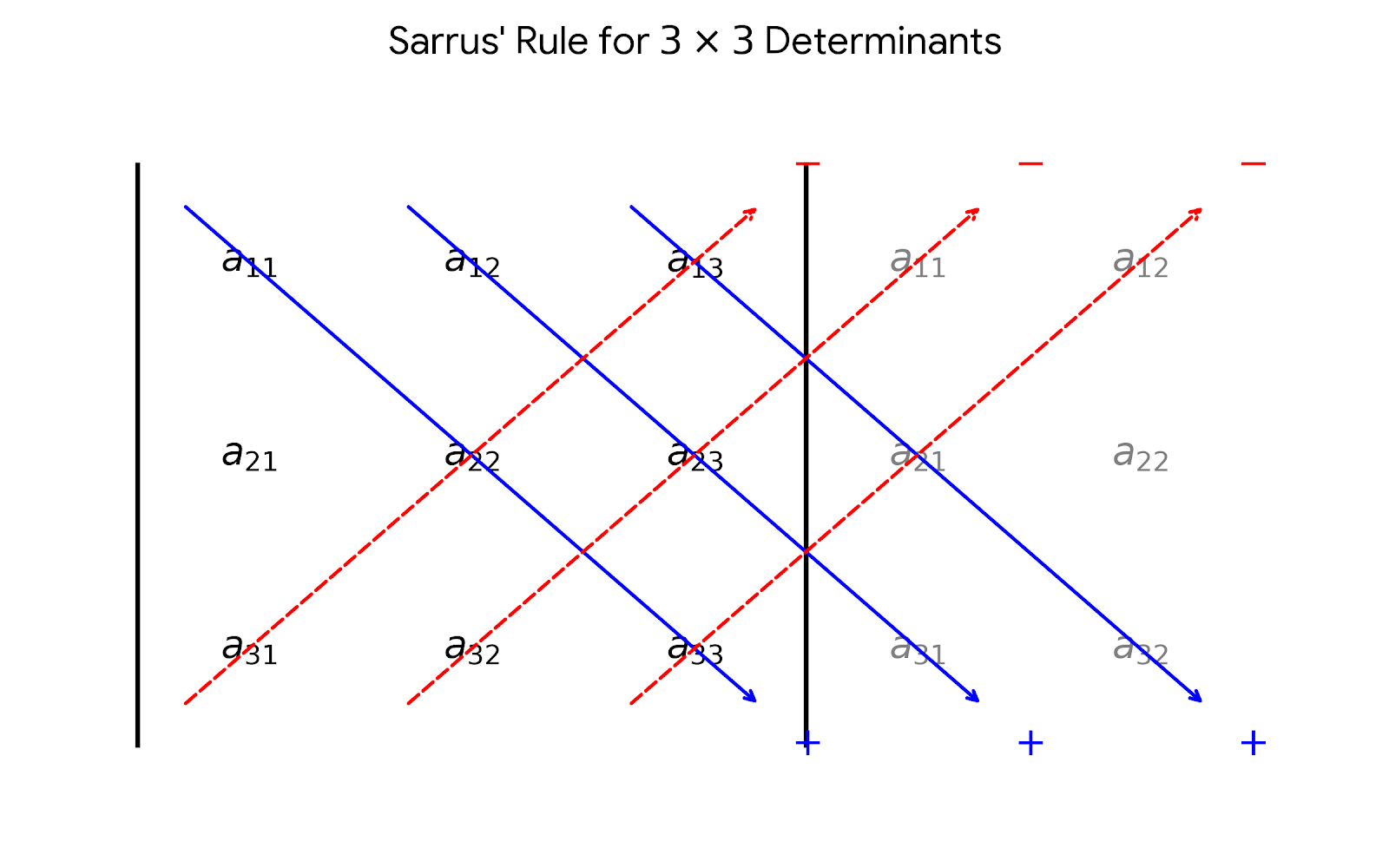
Alternative Device for \(3 \times 3\) Determinants
The expansion of a \(3 \times 3\) determinant can be remembered by the following device: Write a second copy of the first two columns to the right of the matrix. Multiply entries on the six diagonals.
Add the downward diagonal products and subtract the upward diagonal products.
(IV) Properties and Geometric Interpretation
Explore the effect of elementary row operations on the determinant of a matrix.
Let \( A = \begin{bmatrix} a & b \\ c & d \end{bmatrix} \), so \(\det A = ad - bc\).
-
Scaling a Row:
\( A_1 = \begin{bmatrix} 2a & 2b \\ c & d \end{bmatrix} \)
\(\det A_1 = (2a)(d) - (2b)(c) = 2(ad - bc) = 2 \det A\).
Conclusion: If a row operation scales a row by a factor \(k\), the determinant is multiplied by \(k\). -
Row Replacement:
\( A_2 = \begin{bmatrix} a+kc & b+kd \\ c & d \end{bmatrix} \)
\(\det A_2 = (a+kc)d - (b+kd)c = ad + kcd - bc - kcd = ad - bc = \det A\).
Conclusion: Row replacement does not change the determinant. -
Row Interchange:
\( A_3 = \begin{bmatrix} c & d \\ a & b \end{bmatrix} \)
\(\det A_3 = cb - ad = -(ad - bc) = -\det A\).
Conclusion: Row interchange changes the sign of the determinant.
Let \( \vec{u} = \begin{bmatrix} 3 \\ 0 \end{bmatrix} \) and \( \vec{v} = \begin{bmatrix} 1 \\ 2 \end{bmatrix} \). Compute the area of the parallelogram determined by \(\vec{u}\), \(\vec{v}\), \(\vec{u}+\vec{v}\), and \(\vec{0}\). Then, compute the determinant of \( [\vec{u} \quad \vec{v}] \). Replace the 1st entry of \(\vec{v}\) by an arbitrary number \(x\) and repeat the problem.
Initial Case:
- The base of the parallelogram is on the x-axis with length 3. The height is the y-coordinate of \(\vec{v}\), which is 2.
- Area = \(\text{base} \times \text{height} = 3 \cdot 2 = 6\).
- Determinant = \( \begin{vmatrix} 3 & 1 \\ 0 & 2 \end{vmatrix} = (3)(2) - (1)(0) = 6 \).
Case with arbitrary \(x\):
- Let \(\vec{u} = \begin{bmatrix} 3 \\ 0 \end{bmatrix}\) and \(\vec{v} = \begin{bmatrix} x \\ 2 \end{bmatrix}\).
- The base is still 3. The height remains 2 (since the y-coordinate is unchanged). Shearing the parallelogram horizontally does not change its area.
- Area = \(3 \cdot 2 = 6\).
- Determinant = \( \begin{vmatrix} 3 & x \\ 0 & 2 \end{vmatrix} = (3)(2) - (x)(0) = 6 \).
Geometric Note: The absolute value of the determinant of a \(2 \times 2\) matrix equals the area of the parallelogram determined by its column vectors.