(I) The Null Space of a Matrix
Definition
For an \(m \times n\) matrix \(A\), the null space of \(A\), denoted \(\text{Nul } A\), is the set of all solutions of the homogeneous equation \(A\vec{x} = \vec{0}\).
Theorem 2
The null space of an \(m \times n\) matrix \(A\) is a subspace of \(\mathbb{R}^n\).
Equivalently, the set of all solutions to a system \(A\vec{x} = \vec{0}\) of \(m\) homogeneous linear equations in \(n\) unknowns is a subspace of \(\mathbb{R}^n\).
Let \(H = \left\{ \begin{bmatrix} a \\ b \\ c \\ d \end{bmatrix} : a - 2b + 5c = d \text{ and } c - a = b \right\}\).
(1) Show that \(H\) is a subspace of \(\mathbb{R}^4\).
Solution: \(H\) is the set of all solutions of the homogeneous equations:
\[ \begin{cases} a - 2b + 5c - d = 0 \\ -a - b + c = 0 \end{cases} \]This can be written as a matrix equation \(A\vec{x} = \vec{0}\) where:
\[ A = \begin{bmatrix} 1 & -2 & 5 & -1 \\ -1 & -1 & 1 & 0 \end{bmatrix} \]Therefore, \(H = \text{Nul } A\), and it is a subspace of \(\mathbb{R}^4\) by Theorem 2.
(2) Find a spanning set for \(H\).
Solution: Row reduce the coefficient matrix \(A\):
\[ A = \begin{bmatrix} 1 & -2 & 5 & -1 \\ -1 & -1 & 1 & 0 \end{bmatrix} \rightarrow \begin{bmatrix} 1 & -2 & 5 & -1 \\ 0 & -3 & 6 & -1 \end{bmatrix} \rightarrow \dots \rightarrow \begin{bmatrix} 1 & 0 & 1 & -1/3 \\ 0 & 1 & -2 & 1/3 \end{bmatrix} \]Extracting the equations gives:
\[ \begin{cases} x_1 = -x_3 + \frac{1}{3}x_4 \\ x_2 = 2x_3 - \frac{1}{3}x_4 \\ x_3 \text{ is free} \\ x_4 \text{ is free} \end{cases} \]Write the general solution in parametric vector form:
\[ \vec{x} = x_3 \begin{bmatrix} -1 \\ 2 \\ 1 \\ 0 \end{bmatrix} + x_4 \begin{bmatrix} 1/3 \\ -1/3 \\ 0 \\ 1 \end{bmatrix} \]Let \(\vec{v}_1 = \begin{bmatrix} -1 \\ 2 \\ 1 \\ 0 \end{bmatrix}\) and \(\vec{v}_2 = \begin{bmatrix} 1/3 \\ -1/3 \\ 0 \\ 1 \end{bmatrix}\). Then \(\{\vec{v}_1, \vec{v}_2\}\) is a spanning set for \(H\). (This set is also a basis for \(H\)).
Let \(H' = \left\{ \begin{bmatrix} r \\ s \\ t \end{bmatrix} : 5r - 1 = s + 2t \text{ and } r + s = 4 - t \right\}\). Is \(H'\) a subspace of \(\mathbb{R}^3\)?
Solution: The zero vector \(\vec{0}\) is not in \(H'\) because plugging in \(r=0, s=0, t=0\) yields \(-1 = 0\) and \(0 = 4\), which are false (these are non-homogeneous equations). Therefore, \(H'\) is not a subspace.
(II) The Column Space of a Matrix
Definition
Let \(A = \begin{bmatrix} \vec{a}_1 & \dots & \vec{a}_n \end{bmatrix}\) be an \(m \times n\) matrix.
The column space of \(A\), denoted \(\text{Col } A\), is the set of all linear combinations of the columns of \(A\).
\(\text{Col } A\) is the range of the linear transformation \(\vec{x} \mapsto A\vec{x}\).
Theorem 3
The column space of an \(m \times n\) matrix \(A\) is a subspace of \(\mathbb{R}^m\).
Fact: \(\text{Col } A = \mathbb{R}^m\) if and only if the equation \(A\vec{x} = \vec{b}\) has a solution for each \(\vec{b}\) in \(\mathbb{R}^m\).
Determine if the following sets are subspaces of \(\mathbb{R}^3\).
(1) \( W = \left\{ \begin{bmatrix} 6a - b \\ a + b \\ -7a \end{bmatrix} : a, b \in \mathbb{R} \right\} \)
Solution: We can decompose the vector into a linear combination:
\[ \begin{bmatrix} 6a - b \\ a + b \\ -7a \end{bmatrix} = a \begin{bmatrix} 6 \\ 1 \\ -7 \end{bmatrix} + b \begin{bmatrix} -1 \\ 1 \\ 0 \end{bmatrix} \]This shows that \(W = \text{Span}\left\{ \begin{bmatrix} 6 \\ 1 \\ -7 \end{bmatrix}, \begin{bmatrix} -1 \\ 1 \\ 0 \end{bmatrix} \right\}\). Therefore, \(W\) is a subspace of \(\mathbb{R}^3\). Notice that \(W\) is also the column space of the matrix \(A = \begin{bmatrix} 6 & -1 \\ 1 & 1 \\ -7 & 0 \end{bmatrix}\).
(2) \( W' = \left\{ \begin{bmatrix} 6a - b \\ a + b \\ 2 \end{bmatrix} : a, b \in \mathbb{R} \right\} \)
Solution: The zero vector \(\vec{0}\) is not in \(W'\) because the third component is always 2. Therefore, \(W'\) is not a subspace of \(\mathbb{R}^3\).
Let \( A = \begin{bmatrix} 2 & 4 & -2 & 1 \\ -2 & -5 & 7 & 3 \\ 3 & 7 & -8 & 6 \end{bmatrix} \).
Part I: Subspace Dimensions
(a) \(\text{Col } A\) is a subspace of \(\mathbb{R}^3\) (since \(m = 3\)).
(b) \(\text{Nul } A\) is a subspace of \(\mathbb{R}^4\) (since \(n = 4\)).
Part II: Finding Nonzero Vectors
(a) Find a nonzero vector in \(\text{Col } A\).
Solution: Any column of \(A\) works. For example, \(\begin{bmatrix} 2 \\ -2 \\ 3 \end{bmatrix}\).
(b) Find a nonzero vector in \(\text{Nul } A\).
Solution: Solve \(A\vec{x} = \vec{0}\). The RREF of \(A\) is:
\[ A \sim \begin{bmatrix} 1 & 0 & 9 & 0 \\ 0 & 1 & -5 & 0 \\ 0 & 0 & 0 & 1 \end{bmatrix} \]
This gives \(x_1 = -9x_3\), \(x_2 = 5x_3\), \(x_3\) is free, and \(x_4 = 0\). Let \(x_3 = 1\). Then \(\begin{bmatrix} -9 \\ 5 \\ 1 \\ 0 \end{bmatrix}\) is in \(\text{Nul } A\).
Part III: Checking Vector Inclusion
Let \( \vec{u} = \begin{bmatrix} 3 \\ -2 \\ -1 \\ 0 \end{bmatrix} \) and \( \vec{v} = \begin{bmatrix} 3 \\ -1 \\ 3 \end{bmatrix} \).
(a) Determine if \(\vec{u}\) is in \(\text{Nul } A\). Could \(\vec{u}\) be in \(\text{Col } A\)?
Solution: Check \(A\vec{u}\):
\[ A\vec{u} = \begin{bmatrix} 0 \\ -3 \\ 3 \end{bmatrix} \neq \vec{0} \]
So \(\vec{u}\) is not in \(\text{Nul } A\). With 4 entries, \(\vec{u}\) couldn't possibly be in \(\text{Col } A\) since \(\text{Col } A\) is a subspace of \(\mathbb{R}^3\).
(b) Determine if \(\vec{v}\) is in \(\text{Col } A\). Could \(\vec{v}\) be in \(\text{Nul } A\)?
Solution: Check if \(A\vec{x} = \vec{v}\) is consistent. Because \(A\) has 3 pivot columns (based on its RREF), \(\text{Col } A = \mathbb{R}^3\). Therefore, \(A\vec{x} = \vec{v}\) is consistent for any \(\vec{v} \in \mathbb{R}^3\). Thus, \(\vec{v}\) is in \(\text{Col } A\). With 3 entries, \(\vec{v}\) couldn't possibly be in \(\text{Nul } A\) since \(\text{Nul } A\) is a subspace of \(\mathbb{R}^4\).
Contrast Between Nul A and Col A for an \(m \times n\) Matrix
| Nul A | Col A |
|---|---|
| 1. \(\text{Nul } A\) is a subspace of \(\mathbb{R}^n\). | 1. \(\text{Col } A\) is a subspace of \(\mathbb{R}^m\). |
| 2. It takes time to find vectors in \(\text{Nul } A\). (You must solve \(A\vec{x} = \vec{0}\)). | 2. It's easy to find a vector in \(\text{Col } A\). (Any column of \(A\) works; others are generated by them). |
| 3. There is no obvious relation between entries in \(A\) and \(\text{Nul } A\). | 3. There is an obvious relation between entries in \(A\) and \(\text{Col } A\). |
| 4. A vector \(\vec{v}\) is in \(\text{Nul } A\) if \(A\vec{v} = \vec{0}\). | 4. A vector \(\vec{v}\) is in \(\text{Col } A\) if \(A\vec{x} = \vec{v}\) is consistent. |
| 5. \(\text{Nul } A = \{\vec{0}\}\) if and only if \(A\vec{x} = \vec{0}\) has only the trivial solution. | 5. \(\text{Col } A = \mathbb{R}^m\) if and only if \(A\vec{x} = \vec{b}\) is consistent for all \(\vec{b}\) in \(\mathbb{R}^m\). |
| 6. \(\text{Nul } A = \{\vec{0}\}\) if and only if the linear transformation \(\vec{x} \mapsto A\vec{x}\) is one-to-one. | 6. \(\text{Col } A = \mathbb{R}^m\) if and only if the linear transformation \(\vec{x} \mapsto A\vec{x}\) maps \(\mathbb{R}^n\) onto \(\mathbb{R}^m\). |
(III) The Row Space of an \(m \times n\) Matrix
If \(A\) is an \(m \times n\) matrix, each row of \(A\) has \(n\) entries and thus can be identified with a vector in \(\mathbb{R}^n\).
Row A: The row space of \(A\) is the set of all linear combinations of the row vectors.
\(\text{Row } A\) is a subspace of \(\mathbb{R}^n\) for an \(m \times n\) matrix \(A\).
The row vectors are:
- \(\vec{r}_1 = (-2, -5, 8, 0, -17)\)
- \(\vec{r}_2 = (1, 3, -5, 1, 5)\)
- \(\vec{r}_3 = (3, 11, -19, 7, 1)\)
- \(\vec{r}_4 = (1, 7, -13, 5, -3)\)
\(\text{Row } A = \text{Span}\{\vec{r}_1, \vec{r}_2, \vec{r}_3, \vec{r}_4\}\). \(\text{Row } A\) is a subspace of \(\mathbb{R}^5\).
(More about Row A will be discussed in Section 4.3).
(IV) Kernel and Range of a Linear Transformation
Definition
A linear transformation \(T\) from a vector space \(V\) into a vector space \(W\) is a rule that assigns to each vector \(\vec{x}\) in \(V\) a unique vector \(T(\vec{x})\) in \(W\) such that:
- \(T(\vec{u} + \vec{v}) = T(\vec{u}) + T(\vec{v})\) for all \(\vec{u}\) and \(\vec{v}\) in \(V\).
- \(T(c\vec{u}) = cT(\vec{u})\) for all \(\vec{u}\) in \(V\) and all scalars \(c\).
(This implies \(T(\vec{0}) = \vec{0}\)).
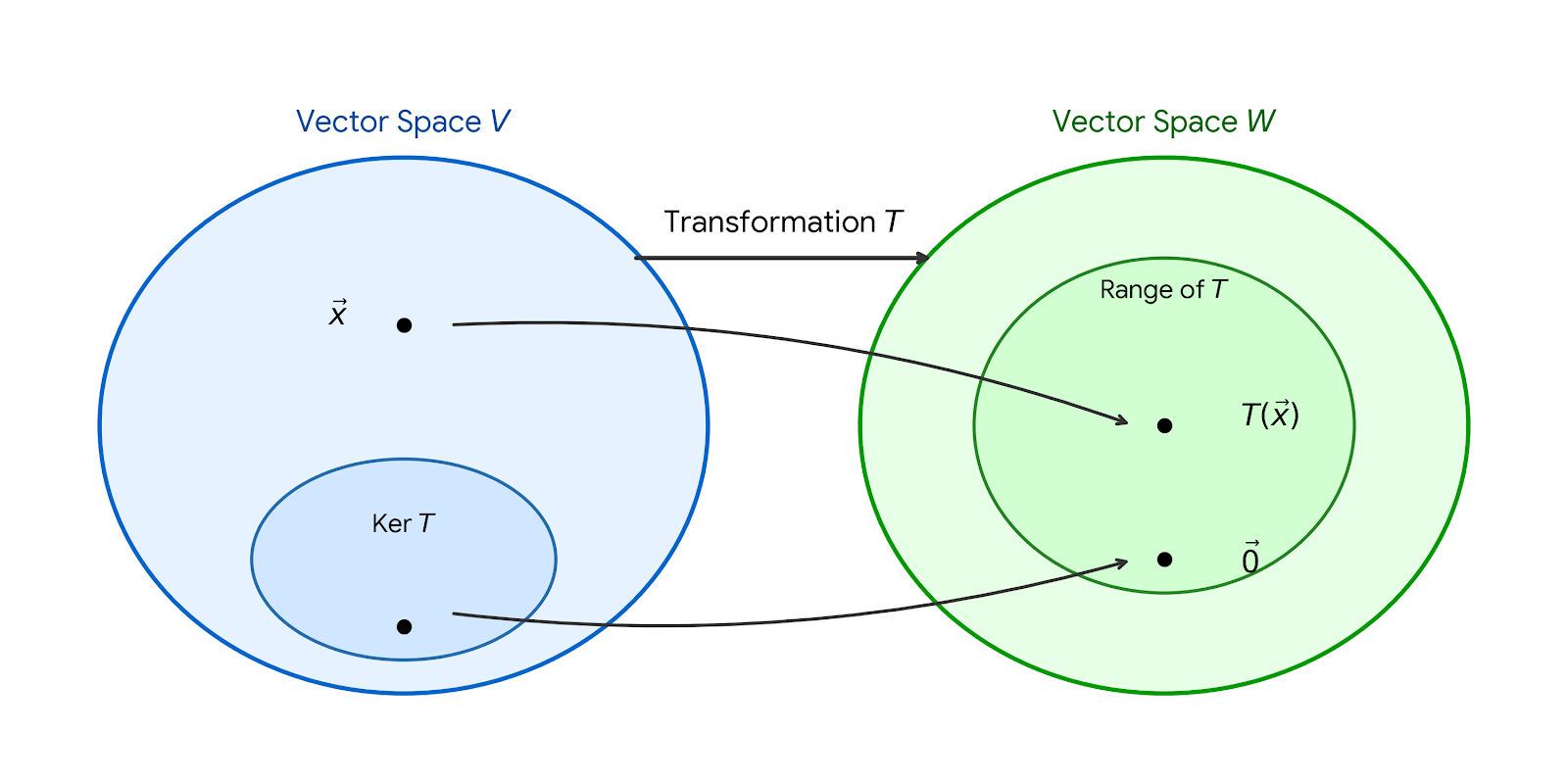
- The Range of \(T\) is a subspace of \(W\).
- The Kernel of \(T\) (ker \(T\)) is the set of all \(\vec{x}\) in \(V\) such that \(T(\vec{x}) = \vec{0}\). It is a subspace of \(V\).
For a matrix transformation \(\vec{x} \mapsto A\vec{x}\):
- \(\text{Nul } A\) is the kernel of the linear transformation.
- \(\text{Col } A\) is the range of the linear transformation.
Define \(T: \mathbb{P}_2 \rightarrow \mathbb{R}^2\) by \( T(p) = \begin{bmatrix} p(0) \\ p(1) \end{bmatrix} \).
For instance, if \(p(t) = 3 + 5t + 7t^2\), then \( T(p) = \begin{bmatrix} 3 \\ 15 \end{bmatrix} \).
(1) Show that \(T\) is a linear transformation.
Solution: For arbitrary polynomials \(p\) and \(q\) in \(\mathbb{P}_2\) and arbitrary scalar \(c\):
\[ T(p+q) = \begin{bmatrix} (p+q)(0) \\ (p+q)(1) \end{bmatrix} = \begin{bmatrix} p(0) + q(0) \\ p(1) + q(1) \end{bmatrix} = \begin{bmatrix} p(0) \\ p(1) \end{bmatrix} + \begin{bmatrix} q(0) \\ q(1) \end{bmatrix} = T(p) + T(q) \] \[ T(cp) = \begin{bmatrix} cp(0) \\ cp(1) \end{bmatrix} = c\begin{bmatrix} p(0) \\ p(1) \end{bmatrix} = cT(p) \]So, \(T\) is a linear transformation.
(2) Find a polynomial \(p\) in \(\mathbb{P}_2\) that spans the kernel of \(T\), and describe the range of \(T\).
Solution: For any quadratic polynomial \(p(t) = at^2 + bt + c\), setting \(T(p) = \vec{0}\) yields:
\[ T(p) = \begin{bmatrix} p(0) \\ p(1) \end{bmatrix} = \begin{bmatrix} c \\ a+b+c \end{bmatrix} = \begin{bmatrix} 0 \\ 0 \end{bmatrix} \]This implies \(c = 0\) and \(a + b + 0 = 0 \implies b = -a\).
Substituting these back into the polynomial gives:
\[ p(t) = at^2 - at = a(t^2 - t) \]This is a multiple of \(t^2 - t\). Thus, \(\text{ker } T = \text{Span}\{t^2 - t\}\).
To describe the range, observe that given any vector \(\begin{bmatrix} x_1 \\ x_2 \end{bmatrix}\) in \(\mathbb{R}^2\), we can define a polynomial \(q(t) = x_1 + (x_2 - x_1)t\). It satisfies \(q(0) = x_1\) and \(q(1) = x_2\). Thus, every vector in \(\mathbb{R}^2\) is the image of some polynomial under \(T\). The range of \(T\) is all of \(\mathbb{R}^2\).