Introduction to Algebraic
Geometry
(Math 665, spring 06)
Donu Arapura
Blow up
- Examples
- Geometry of 2x2 nilpotent matrices
- Blowing up a cusp
- Lines in projective 3 space
- Computer Examples
- Nilpotent matrices revisited
- Singular Locus
- Pluecker Equation
- Fano Variety
- Dual Curve
- Books
Examples
In order to get a feeling for what algebraic geometry is, let's to go through
some simple examples.
Consider the space of 2x2 matrices
over a field k with trace 0. These can be parameterized by 3-tuples
(x,y,z) where x, y
and z appear in the 11, 12, and 21 positions; therefore this can be
identified with three dimensional affine space A3. In these coordinates the
determinant det(x,y,z) = -x2 -yz. The determinant is
an regular
map A3 → A1. The
fibers
Xt=det-1(t) = {(x,y,z) | det(x,y,z)
= t}
are algebraic subsets of A3. These are in fact
varieties since the polynomials -x2 -yz-t are
irreducible for each t in k.
Let's study the geometry of these sets.
Suppose k=C, then I claim
that Xt is isomorphic to X1 whenever t is nonzero.
To see this, choose a such that a2 = t, then the map (x,y,z) → (ax,ay,az)
defines an isomorphism between
X1 and Xt; this can be checked by comparing coordinate rings.
( This
works even if C is replaced by an algebraically closed field. But it
fails in general. For example when k = R,
X1 is connected in it's usual topology while X-1 isn't.)
I claim that X1 is a
homogeneous space which implies that
any point looks like any other point. To see this, observe that
the algebraic group SL2(C) acts on X1 by matrix
conjugation, and that this is a transitive action.
This last statement can be checked by brute force: a matrix A in SL2(C) sends (1,0,0) to
(1+2a21a12,
-2a11a21,
2a12a22)...

X1
X0 is the space 2x2 matrices with zero trace and zero determinant. It
follows by the Cayley-Hamilton theorem that this is precisely the
set of nilpotent matrices of the form N2=0. There is a
subtle point here. If I is the ideal generated by trace and det of a
generic 2x2 matrix, and J
is the ideal generated by the entries of its square, then
the I and J have the same radical but they not the
same (see below). Thus they define different
schemes with the same reduced structure.
The zero matrix is a singular
point of, while the other points are nonsingular. This can be
checked by setting the partial derivatives of the equation
-x2 -yz to zero. It
follows that X0 is not homogeneous, and therefore X0 is not
isomorphic to X1. Alternatively, these cannot be isomorphic since all
the points of X1 are nonsingular.

X0
What we've been doing so far is affine geometry.
We get a little more insight into the structure of
these sets by doing projective geometry. A matrix
in X-1 has 1 and -1 as its eigenvalues. The eigenvectors
span two distinct lines in C2. Conversely, a pair of distinct
lines determines an element of X-1. Thus we have
a bijection, and in fact isomorphism, between the
X-1 and the product of two copies of the
projective line
minus the diagonal. Thus X-1 is a so called
doubly ruled surface. These rulings, which are fibers of the
projections onto the factors, are embedded as lines in A3.
In fact, after a linear change of coordinates
the embedding of X-1 into A3 extends to the
Segre embedding of P1xP1 to P3.
-1

Double ruling (red and black lines)
It follows from above that X-1 is birational to the P1xP1 and
therefore to A2. However, it is not isomorphic to A2.
This is because the coordinate ring A(A2) = k[x1,x2] is
a unique factorization domain, while A(X-1)= k[x,y,z]/(1-x2-yz)
isn't (the image of yz can be factored in two different ways, as
(1-x)(1+x) and the obvious way).
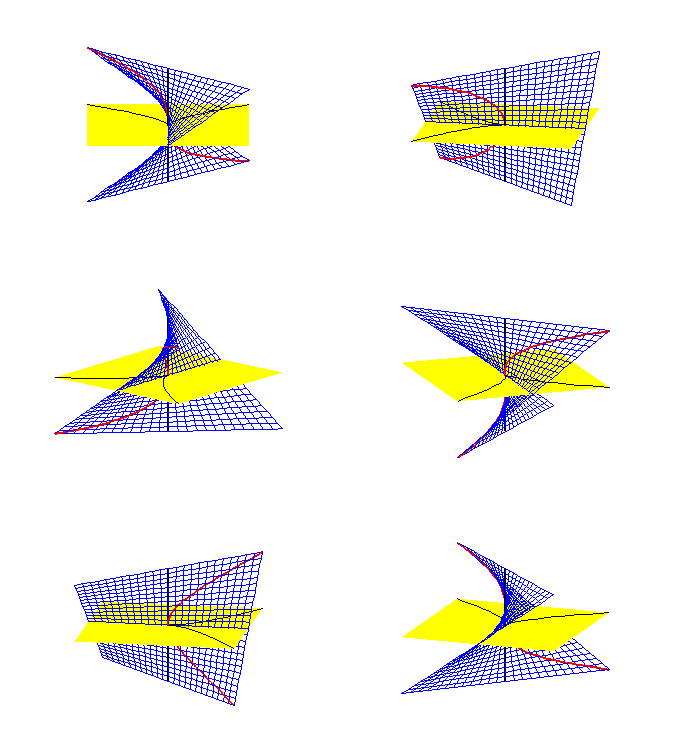
The second example, which is the one indicated in the picture
at the top of this page, is the blow up of the affine plane. This consist of a quasiprojective variety Bl and a
morphism p:Bl → A2,
where Bl consists
of pairs (x,L) where x is point in A2 and L point
in P1 containing x, and
p(x,L) = x. The morphism p induces isomorphism p -1
A2-{(0,0)} → A2-{(0,0)}. Therefore p is a
birational equivalence.
However, p is not an isomorphism, since
the preimage E = p -1 (0,0) is P1 rather than a point.
Bl can be
described as a union of two affine varieties,
Bl1={(x,y,t) | y=xt} and Bl2={(x,y,u) | x=yu}
glued via (x,y,t) → (x,y,1/t). Bl1 is blue surface
depicted above.
The curve C = {(x,y) | y2=x3} in A2
is singular at (0,0). Its preimage under p, called its total
transform, is the union of E with a curve C2 (the red curve).
C2, which can be described as the closure of the
preimage of C-{(0,0)}, is called the strict transform.
This curve lies in Bl1 and is given parametrically by x=s2, y=s3, t=s.
The map A1 → C2 given by s → (x,y,t) is an isomorphism,
since t → s is the inverse, therefore C2 is smooth.
Since C2 and C are isomorphic away from (0,0), they are
birational. The
map on coordinate rings A(C) = k[x,y]/(y2-x3) → A(A1) = k[s]
is given by x → s2, y → s3, so A(C) can be identified
with the subring of k[s] generated by s2 and s3.
C2 → C is an example of resolution of singularities.
Exercise: Carry out a similar analysis for the node y2=x2(x+1)
A line in the projective plane is given by a nonzero linear equation
in 3 variables, and two equations determine the same line if they are
multiples of each other. Thus the set of lines in P2
is parameterized by another P2 called the dual plane.
Now let's look at the the set of lines
in P3.
we claim that the set of these lines is
parameterized by a projective variety called the Grassmanian
G(2,4). We want to know how big it is;
in other words, we want to
compute its dimension of .
A line in P3 is
determined by a pair of distinct points, thus we arrive at an upper
bound 6=2x3. Under the identification P3
=k4-{0}/scalars, a line corresponds to a two
dimensional subspace of V= k4. A pair of distinct points on
the projective corresponds to a pair of linear independent vectors
v1, v2 i.e. a basis of the subspace. Let
M be the 2x4 matrix with rows given by the v's. M and M' determine the
same subspace if and only if M' = AM for A ∈
GL2(k). Thus we could hope to identify G(2,4) with
quotient of the affine space of 2x4 matrices by GL2(k).
In particular, we should obtain the dimension as the difference 4=2x4-4.
Since there is no a priori reason for the quotient variety to exist, we
sketch an alternative construction. We form the wedge product of the
vectors pl(M)= v1Λ v2 in the 2nd exterior power Λ2V.
Note that pl(AM) = det(A)pl(M), thus the class of [pl(M)] in the
projective space P(V) depends only on the point of the
Grassmanian. This gives an embedding of G(2,4) to P(V). The image is
the set of points satisfying the Pluecker condition pl Λ pl =0.
After identifying Λ2V with k6, the
Plueker condition becomes a polynomial condition
(see below).
Thus G(2,4) becomes a hypersurface in P5. In particular, its dimension
is 4 as claimed.
Let U ⊂ G(2,4) be
the open set of lines meeting A3 and with nonconstant
projection to the x-axis. The lines in U admit a unique parameterization
of the form y =ax + b, z=cx+d. Thus U is isomorphic
to A4. Thus G(2,4) is birational to A4.
Computer Examples
There are a few
of software packages that can help with working out examples.
For general purpose algebraic
manipulation, graphics etc. there's
Maple or
Mathematica. (I tend to
use Maple since it's is available on most of our machines
including all our Suns.)
Some examples of the use of Maple for
algebro-geometric calculations can be found in the books of Cox
et. al below. Here, I'll just give the code for generating the
graph of the blow up at the top of this page.
with(plots):
Bl := plot3d([x,x*t, t], x=-1..1, t=-1..1, style=WIREFRAME, color =blue):
A2 := plot3d([x,y,0], x=-1..1, y=-1..1, color=yellow, style=PATCHNOGRID):
E := spacecurve([0,0,t], t=-1..1, color=black, thickness=2):
C := spacecurve([s^2, s^3, 0], s=-1..1, color=black, thickness=1):
C2 := spacecurve([s^2,s^3,s], s=-1..1, color=red, thickness=2):
display({Bl,A2, E, C, C2});
****
For doing calculations
in algebraic geometry and commutative algebra, Grayson and Stillman's
Macaulay2
program is more powerful than Maple or Mathematica.
Documentation is available on the
web. (There are a couple of other programs, CoCoA and Singular, with
similar capabilities, but I'm less familiar with these.)
To get a sense for what it can do, let's consider some simple
examples. Assuming things have been set up properly,
you can start the program by typing M2 in a terminal window of one of
our Suns or whatever machine you're using. If you plan to do anything serious,
you'll need to learn how to run it under emacs.
As a first example, let's check a special case of the Cayley-Hamilton theorem.
R = QQ[x_1..x_4]
This sets up a polynomial ring over Q (= QQ in Macaulay) in 4 variables. Next
define the ideal I generated by det and trace of the "universal"
2x2 matrix M by typing
M = matrix{{x_1,x_2},{x_3,x_4}}
D = det M
T = trace M
I = ideal {D, T}
The algebraic set V(I) in A4
(= space of 2x2 matrices) is the set of matrices with det= trace = 0
Let Nilp be the set of matrices whose square vanishes. The
entries of M2 generate an ideal J which can be constructed by
J = ideal M^2
Then Nilp = V(J). By the Cayley-Hamilton theorem, V(I) coincides with
Nilp as well. Let's check this directly.
In order verify V(I) = V(J) (over any algebraically closed field of
char. 0), it's enough, by the
Nullstellensatz, to check
the equality of the radicals of I and J:
radical I == radical J
Exercise: check whether I = J? If not, then what goes wrong?
Next, let's check that the hypersurface f = z2 -(y-1)(y2-x)= 0
in A3 has
exactly one
singular point at (1,1,0)
over an algebraically closed field of large positive characteristic
(Macaulay2 computes more efficiently over finite fields).
We need
to clear the previous use of x before defining the new objects
erase symbol x
R = ZZ/31991[x,y,z]
f = z^2 -(y-1)*(y^2-x)
The graph (which is a bit misleading) suggests that the hypersurface
might be reducible. We can check that it's irreducible over the prime
field Z/31991 by trying to factor it:
factor f
Next define the ideal Jac generated by f and its partials.
Jac = ideal { f, diff(x,f), diff(y,f), diff(z,f)}
The singular locus of f is precisely V(Jac). It
is enough by the
Nullstellensatz to check the radical of Jac is the maximal ideal
(x-1,y-1,z)
radical Jac
For the next example, we want to find the explicit Pluecker
equations for G(2,4).
Let's identify A8 with space of 2x4 matrices.
Consider the morphism
pl:A8 → A6
given by sending a matrix to
the vector of its 2x2 minors (in some order). Let X be the image of
F, and let's find I(X).
Let R and S be the
coordinate rings of these affine spaces.
Rather than clearing all the previous variables on by one, we can
restart the program:
restart
R = QQ[x_1..x_8]
S = QQ[y_1..y_6]
Let p be homomorphism of coordinate rings S → R determined by pl.
M = genericMatrix(R,x_1,2,4)
M2 = exteriorPower(2,M)
p = map(R,S, M2)
Then I(X) = ker(p)
ker p
For this example, we show that the Fermat cubic surface
in P3 has only finitely many lines on it.
We do this by
computing the dimension of the so called Fano variety of lines lying
on it. To simplify our
analysis, we work on the affine surface x3 + y3 +
z3 + 1=0. Also we will be content to restrict our
attention to the lines in U ⊂ G(2,4) described above. We leave it
as an exercise to finish the analysis.
Substituting y= ax+b, z=cx+d into the above equation and expanding
yields conditions on a,b,c,d which defines the Fano variety.
Now, we compute the dimension of the coordinate ring F of the Fano
variety.
restart
R = QQ[a..d]
I = ideal{a^3+c^3+1, a^2*b+c^2*d, a*b^2+c*d^2, b^3+d^3+1}
F= R/I
dim F
should yield 0.
Exercises: 1. Complete the analysis. 2. Any nonsingular cubic
contains 27 lines. Find them in this example.
For the last example, we compute the equation of the dual curve of the Fermat
quartic curve C: x4 + y4 +z4 = 0.
This is the set of tangent lines to this curve in the dual
projective plane (P2)*. We can compute the dual
curve by projecting the incidence variety
{([x,y,z],[a,b,c])
∈ P2x(P2)* |
[x,y,z] ∈ C, a=4x3,b=4y3,c=4z4}
to (P2)*, and then using elimination theory to find
the relation among a,b,c. In algebraic terms this amount to
intersecting the ideal I defining the incidence variety in
k[a,b,c,x,y,z] with k[a,b,c]. We do this in 2 ways. In the first approach,
we have to get our hands a bit dirty, but we do get a glimpse of what is
really being computed behind the scenes. The idea (see Eisenbud pp 360-361 )
is to compute a Groebner basis
with respect to an ordering
called an elimination order with respect to x,y,z, and then discard
the elements of this basis involving x,y, or z. It will turn out that
the first element is the one we want, at least in Macaulay2.
restart
K= ZZ/31991
R = K[x,y,z,a,b,c, MonomialOrder => Eliminate 3]
I = ideal {x^4+y^4+z^4, a-4*x^3, b-4*y^3, c-4*z^3}
G = gens gb I
G_{0}
This should have degree 12. The second approach is simply
to express the intersection of I with k[a,b,c] as the
kernel of natural map f: k[a,b,c] → k[x,y,z,a,b,c]/I. Since Macaulay
doesn't allow variables to live in different rings,
so we use A, B, C for the initial ring and
map these to a, b, c in the quotient by f.
Q = R/I
S = K[A,B,C]
f = map(Q,S,{a,b,c})
ker f
When we're finished, type
quit
Books
Harris was the text for this class the last time I taught it.
I haven't decided about next semester.
This and additional references are
- M. Atiyah, I. MacDonald, Commutative Algebra
- D. Cox, J. Little, D. O'Shea, Ideals, Varieties and Algorithms
- D. Cox, J. Little, D. O'Shea , Using Algebraic Geometry
- D. Eisenbud, Commutative Algebra
- D. Eisebud, J. Harris, Geometry of Schemes
- J. Harris, Algebraic geometry: a first course
- R. Hartshorne, Algebraic geometry*
- D. Mumford, Red book of varieties and schemes*
- I. Shafarevich, Basic Algebraic Geometry
The starred references would be a little heavy going as an introduction.
Back to beginning.
Last revision Sep 27, 05