
Handout Lesson 11, Acceleration, Velocity, and Resistance

Textbook Section(s).

This lesson is based on Section 2.3 of your textbook by Edwards, Penney, and Calvis.

A Revised Model for Acceleration and Velocity.

Every model is based on assumptions. When you create your first model, you use assumptions that make your model as simple as possible. You have to make sure that the simple model is working before you move on to test more complicated models. In other words, you have to walk before you can run.
Earlier this semester:
  • We modeled the acceleration of an object that was moving vertically.
  • Simple asssumption 1: The only force acting on the object was the acceleration due to gravity.
  • Simple assumption 2: The acceleration due to gravity is
    \begin{equation*} g \approx 9.8 \text{m/s}^2 \qquad \text{ or } g \approx 32 \text{ft/s}^2 \end{equation*}
Differences in models could be attributed to the choice of axis system.
Today we add a new assumption that the object moving vertically is also being acted on by a force due to air resistance. So we have:
NEW Assumption:
\begin{equation*} F=F_G+F_R \end{equation*}
where:
  • \(F\) is the total force acting on the object moving vertically.
  • \(F_G\) is the force acting on the object due to gravity.
  • \(F_R\) is the force acting on the object due to resistance.
Experiments have shown that models for air resistance can be complex, but in reality it is often reasonable (i.e., within an acceptable error tolerance) to assume that \(F_R\) is proportional to \(v^p\) for some \(p \in [1,2]\text{.}\) In other words,
\begin{equation*} F_R \approx -kv^p \end{equation*}
for some positive constant \(k\) and some constant \(p\) satisfying \(1 \leq p \leq 2\text{.}\)
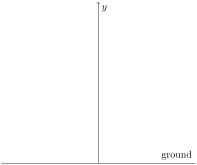
AXIS SYSTEM: Today, I will always orient my axis for vertical motion problems so that the origin is at ground level and the positive direction is pointing upward.
Axis systems are arbitrary. They must be declared for the sake of communication. Your textbook discusses another choice for the axis system if you would like to explore this more.

Vertical Motion with Air Resistance Proportional to Velocity.
described in detail following the image
An axis systim with vertical axis labeled by \(y\text{.}\) The positive direction is pointing up and the origin is at ground level.
Example 68. Falling object with wind resistance.

(Exercise 1 from Section 3.4 of the Differential Equations textbook by Nagle, Saff, and Snider)
A 5 kg object is dropped from a height of 1000 m. Forces due to gravity and air resistance are acting on the object. The force due to air resistance is proportional to the velocity with \(k=\) 50 NΒ·s⁄m
  1. When will the object hit the ground? (NOTE: This problem requires a graphing utility. You could not be asked to solve this problem on an exam, but the principles used up until the very last step are still valid concepts for the exam.)
    described in detail following the image
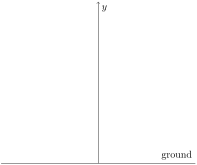
    An axis systim with vertical axis labeled by \(y\text{.}\) The positive direction is pointing up and the origin is at ground level.

  2. What happens to the velocity of the object as \(t \rightarrow \infty\text{?}\) In other words, what is the limiting velocity of the object?

Some additional comments.

  1. Maximum height. If an object is shot up in the air, then it reaches its maximum height when .
  2. The homework problems do not necessarily deal with vertical motion. They may deal with horizontal motion, but the principals of resistance can still apply.

Example 69. Resistance in a liquid.

(Based on Number 2 from Section 2.3 of your textbook by Edwards, et.al.)
Suppose that a body is moving horizontally through a resisting liquid with resistance proportional to its velocity. In symbols,
\begin{equation*} \frac{dv}{dt}=-kv \end{equation*}
  1. Find formulas for its velocity and position if \(x_0=0\text{,}\) \(v_0=10\) and \(k=5\text{.}\)
  2. Find the distance traveled by the particle. (In other words, explore \(\lim_{t \rightarrow \infty} x(t)\text{.}\))
