A Revised Model for Acceleration and Velocity.
Every model is based on assumptions. When you create your first model, you use assumptions that make your model as simple as possible. You have to make sure that the simple model is working before you move on to test more complicated models. In other words, you have to walk before you can run.
Earlier this semester:
Differences in models could be attributed to the choice of axis system.
Today we add a new assumption that the object moving vertically is also being acted on by a force due to air resistance. So we have:
NEW Assumption:
\begin{equation*}
F=F_G+F_R
\end{equation*}
where:
-
\(F\) is the total force acting on the object moving vertically.
-
\(F_G\) is the force acting on the object due to gravity.
-
\(F_R\) is the force acting on the object due to resistance.
Experiments have shown that models for air resistance can be complex, but in reality it is often reasonable (i.e., within an acceptable error tolerance) to assume that \(F_R\) is proportional to \(v^p\) for some \(p \in [1,2]\text{.}\) In other words,
\begin{equation*}
F_R \approx -kv^p
\end{equation*}
for some positive constant \(k\) and some constant \(p\) satisfying \(1 \leq p \leq 2\text{.}\)
AXIS SYSTEM: Today, I will always orient my axis for vertical motion problems so that the origin is at ground level and the positive direction is pointing upward.
Axis systems are arbitrary. They must be declared for the sake of communication. Your textbook discusses another choice for the axis system if you would like to explore this more.
Vertical Motion with Air Resistance Proportional to Velocity.
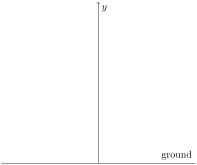
An axis systim with vertical axis labeled by
\(y\text{.}\) The positive direction is pointing up and the origin is at ground level.