Worksheet Lesson 2, Using Integration to Solve Simple Differential Equations

Textbook Section(s).

This lesson is based on Section 1.2 of your textbook by Edwards, Penney, and Calvis.

Differential Equations of the form \(\frac{dy}{dx}=f(x)\).

A differential equation of the form:
\begin{equation*} \frac{dy}{dx}=f(x) \end{equation*}
has general solution
\begin{equation*} y(x)=\int f(x) \, dx +C \end{equation*}
(The β€œ\(+C\)” is redundant, but I included it to stress that the generic constant is required in a general solution.)
If you have an IVP of the form
\begin{equation*} \frac{dy}{dx}=f(x), \qquad y(a)=b \end{equation*}
then you can find the particular solution for the IVP by substituting \(a\)for \(x\) and \(b\)for \(y\) in the general solution. Then solve for \(C\text{,}\) and replace the \(C\) in the general solution with the value you found.

Example 9. Solving an IVP.

Find the function \(y=f(x)\) satisfying the differential equation and the initial condition. (In other words, solve the IVP.)
\begin{equation*} \frac{dy}{dx}=(2x-1)^3 \qquad y(1)=\frac{5}{8} \end{equation*}

Example 10. Solving an IVP.

Solve the IVP.
\begin{equation*} \frac{d^2y}{dx^2}=6x, \qquad y'(0)=5 \qquad y(1)=8 \end{equation*}

Application: Acceleration, Velocity, and Position.

Recall the relationships between the acceleration (\(a(t)\)), the velocity (\(v(t)\)), and the position (\(x(t)\)) of a particle traveling on a straight line.
So if we are given a formula \(a(t)\) for the acceleration, then we have a second-order differential equation of the form
\begin{equation*} \frac{d^2x}{dt^2}=a(t) \end{equation*}
If we are given initial values for the velocity (\(v(0)=v_0\)) and the position (\(x(0)=x_0\)), then we have an IVP that can be used to find a formula for \(x(t)\text{.}\)

Example 11. Find position function from acceleration function and initial values.

Find the position function \(x(t)\) of a particle moving on a straight line with acceleration \(a(t)=2t+1\text{,}\) initial position \(x_0=4\text{,}\) and initial velocity \(v_0=-7\text{.}\)

Example 12. Use graph of velocity function to sketch graph of position function.

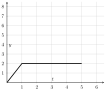
A particle starts at the origin and travels along the \(x\)-axis with velocity function \(v(t)\) shown in the graph. Sketch the graph of the position function \(x(t)\) for \(0 \leq t \leq 5\text{.}\)
a graph of the a velocity function
The velocity function starts at the origin, increases linearly to the point \((1,2)\text{,}\) and then holds constant from \((1,2)\) to \((5,2)\text{.}\)

Vertical Motion and Gravity.

If an object is traveling vertically on Earth, then its acceleration due to gravity is approximately
\begin{equation*} g \approx -9.8 \, m/s^2 \approx -32 \, ft/s^2 \end{equation*}
I have used a negative for \(g\) because I am envisioning a vertical number line that is increases away from the ground.

Example 13. Vertical position, velocity, and acceleration.

(Number 27 from Section 1.2 in your textbook by Edwards, Penney, Calvis (3rd edition))
A ball is thrown straight down from the top of a tall building. The initial speed of the ball is 10 m/s. It strikes the ground with a speed of 60 m/s. How tall is the building?

Example 14. Position, velocity, and acceleration.

(Number 38 from Section 1.2 in your textbook by Edwards, Penney, Calvis (3rd edition))
A noon a car starts from rest at point \(A\) and proceeds with constant acceleration along a straight road toward point \(C\text{,}\) 35 miles away. If the constantly accelerated car arrives at \(C\) with a velocity of 60 miles per hour, at what time does it arrive at \(C\text{?}\)