Handout Lesson 6, First-order Linear Differential Equations, Part II

Textbook Section(s).

This lesson is based on Section 1.5 of your textbook by Edwards, Penney, and Calvis.

Uniqueness Theorem for First-order Linear IVP’s.

Remarks.

  1. Compare this theorem to the Existence and Uniqueness Theorem we learned in Section 1.3.
  2. First-order linear differential equations do not have singular solutions. All of the solutions are of the form given in (✢).
  3. You can slightly modify our definition of the integrating factor for the IVP so that \(C\) can be found automatically. It is easy to check that \(\rho(x_0)=1\) and \(y(x_0)=y_0\) with the following definitions.
    \begin{gather} \rho(x)=e^{\int_{x_0}^x P(w) \, dw}\tag{†}\\ y(x)= \frac{1}{\rho(x)} \Biggr[\int_{x_0}^x \rho(w)Q(w) \, dw +y_0 \Biggr]\tag{#} \end{gather}

Mixture Problems.

Consider a tank containing a well-mixed solution. The solution consists of
  • A solute (what is dissolved)
  • A solvent (the liquid that dissolves the solute)
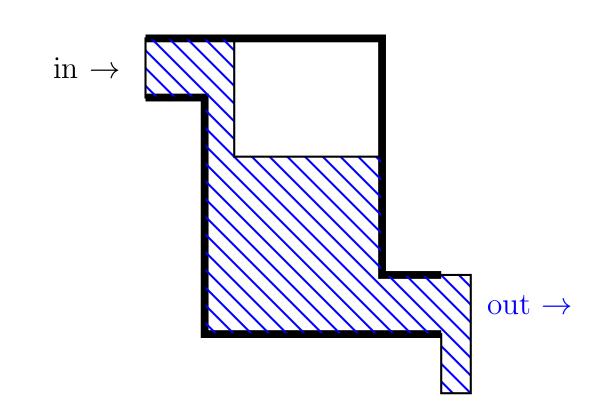
described in detail following the image
The picture illustrates a tank in which liquid is flowing into the top of the tank and flowing out of the tank at the bottom of the tank.
We will use the following notation:
  1. \(x(t)=\) the amount of solute in the tank at time \(t\)
  2. \(V(t)=\) the volume of solution in the tank at time \(t\)
  3. The mixture flowing into the tank has concentration \(c_i\) and is flowing in at the rate of \(r_i\)
  4. The mixture flowing out of the tank has concentration i \(c_o\) and is flowing in at the rate of \(r_o\)
For now, \(c_i\text{,}\) \(r_i\text{,}\) and \(r_o\) will be constants.
Model for \(x(t)\text{:}\)

Example 39. A mixture problem.

(Exercise 1.4.8 from T. Bazett’s website)
Five grams of salt are dissolved in 20L of water. Brine with a concentration of 2 grams of salt per liter is added at a rate of 3 L/min. The tank is well mixed and drains at a rate of 3 L/min. When does the tank contain 20 g of salt?

Example 40. Another mixture problem.

(Exercise 1.4.12 from T. Bazett’s website)
A tank is full of 10 L of clear water. The thoroughly mixed solution is being pumped out at a rate of 3 L/min. A toxic solution is being pumped in at a rate of 2 L/min and a concentration of $20t$ grams of toxins per liter of solution. How many grams of toxins are in the tank when the tank is half full?