Fioralba Cakoni: 2026 Math Is Key
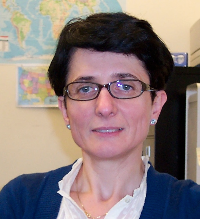
Distinguished Professor of Mathematics
Rutgers University - New Brunswick
Dr. Fioralba Cakoni is a Distinguished Professor of Mathematics at Rutgers University, New Brunswick. She started her career as a Humboldt Research Fellow at the University of Stuttgart, and after that, she joined the faculty at the University of Delaware. Since then, Dr. Cakoni has become a leading expert in the area of mathematical analysis and PDEs, focusing on inverse scattering theory. In 2016, Dr. Cakoni became a Simons Fellow and was elected as an AMS Fellow in 2019. More recently, she became a SIAM Fellow in 2023 and will be giving the AWM-SIAM Kovalevsky Lecture at the 2026 SIAM Annual Meeting. As of January 2026, she is the editor-in-chief of the “Inverse Problems” journal.
Dr. Cakoni has co-authored over 100 papers and multiple books throughout her career, with the books being required reading for those studying qualitative methods in inverse scattering. With her collaborators, Dr. Cakoni pioneered the study of qualitative reconstruction methods. These are computationally simple yet analytically rigorous methods for shape reconstruction. Initially, these methods were developed for acoustic scatterers in the frequency domain (i.e., elliptic equations) but have been expanded to imaging modalities governed by hyperbolic and parabolic equations. Her work in this area led to many new ideas associated with inverse scattering theory. Indeed, the so-called transmission eigenvalue problems associated with inverse scattering have been an active area of interesting research for many years. This is because these are non-self-adjoint and nonlinear eigenvalue problems that are not covered by standard analytical tools, making them particularly challenging and requiring innovative approaches for their analysis and solution. Throughout her career, Dr. Cakoni has mentored 7 Ph.D. students and 7 postdoctoral scholars, as well as organized many workshops.
NEW SPECTRAL PROBLEMS FOR OLD QUESTIONS
Abstract: This lecture concerns new eigenvalue problems that arise in inverse scattering theory.
From Lord Rayleigh’s explanation of why the sky is blue to Rutherford’s discovery of the atomic nucleus, and more recently to modern technologies such as computerized tomography and wave-based imaging, scattering theory has played a central role in mathematical physics. At its core, scattering theory studies how waves interact with a medium and how the resulting scattered waves encode information about the structure of that medium. While the underlying mathematical models are often deceptively simple, typically linear partial differential equations, the phenomena they describe continue to challenge and inspire mathematicians across many areas. Inverse scattering theory, on the other hand, seeks to recover information about an unknown medium from measurements of waves scattered by it. This task is inherently nonlinear and ill-posed, raising fundamental questions of uniqueness, stability, and the design of reliable reconstructions.
In this lecture, I will discuss how the analysis of scattering data leads naturally to spectral problems that can be used to image scattering media. The idea of recovering geometric or physical information about an object from spectral data has a rich history in mathematics. Classical examples include Mark Kac’s famous question, “Can one hear the shape of a drum?”, and inverse Sturm–Liouville problems. In recent years a new class of spectral problems have been discovered in scattering theory, which opens up new perspectives on the interplay between spectral theory, partial differential equations, and inverse problems.
The goal of this lecture is to provide an accessible overview of these developments and their role in modern wave imaging.
This lecture occurred Tuesday, March 31, 2026.