(Number 2.5.15 from Trefor Bazett’s web site)
Print preview
Handout Lesson 18, The Method of Undetermined Coefficients
Textbook Section(s).
This lesson is based on Section 3.5 of your textbook by Edwards, Penney, and Calvis.
Nonhomogeneous equations with constant coefficients.
Today, we continue our study of nonhomogeneous linear differential equations with constant coefficients.
\begin{gather}
a_ny^{(n)}+a_{n-1}y^{(n-1)}+\dots+a_{1}y'+a_0y=f(x)\tag{✶}
\end{gather}
where \(a_0, a_1, \dots, a_{n-1}, a_n\) are all constants.
Recall:
-
The spring equation\begin{equation*} mx''+cx'+kx=F_E \end{equation*}where \(F_E\) represents the is an equation of the type in (✶).
-
-
\(y_c\) is
-
\(y_p\) is
-
Example 129. A first example of the method of undetermined coefficients.
Educated guesses for particular solutions.
For
\begin{gather}
a_ny^{(n)}+a_{n-1}y^{(n-1)}+\dots+a_{1}y'+a_0y=f(x)\tag{✶✶}
\end{gather}
where \(a_0, a_1, \dots, a_{n-1}, a_n\) are all constants.
| If \(f(x)\) is . . . | Educated Guess for \(y_p\) |
|---|---|
| a polynomial of degree \(m\) | \(\spc{5in}\) |
| \(a\cos(\omega x)+b\sin(\omega x)\) | \(\spc{5in}\) |
| \(e^{rx}\) | \(\spc{5in}\) |
If \(f(x)\) in (✶✶) has the form
\begin{equation*}
P_m(x)e^{rx}\cos(\omega x)
\quad \text{ or } \quad
P_m(x)e^{rx}\sin(\omega x)
\end{equation*}
where \(P_m(x)\) is a polynomial of degree \(m\text{,}\) then our educated guess for \(y_p\) would be
If the polynomial, exponential, or trigonometric function is missing from \(f(x)\text{,}\) then the guess can be modified accordingly. So the educated guess for \(f(x)=P_m(x)\cos(\omega x)\text{,}\) then the educated guess would be
Theorem 131. Superposition Theorem.
Let \(L=a_nD^n+a_{n-1}D^{n-1}+\dots+a_1D+a_0\text{.}\) If \(y_1\) is a solution to
\begin{equation*}
L[y]=f_1(x)
\end{equation*}
and \(y_2\) is a solution to
\begin{equation*}
L[y]=f_2(x)
\end{equation*}
then for constants \(k_1\) and \(k_2\text{,}\) \(k_1y_1+k_2y_2\) is a solutions to
\begin{equation*}
L[y]=k_1f_1(x)+k_2f_2(x)
\end{equation*}
Modifying your educated guess.
Sometimes, our educated guess for the particular solution simply does not work. The following example came from Professor Bell’s notes.
Example 133. An educated guess that does not work.
Desmos was used to make the graph.
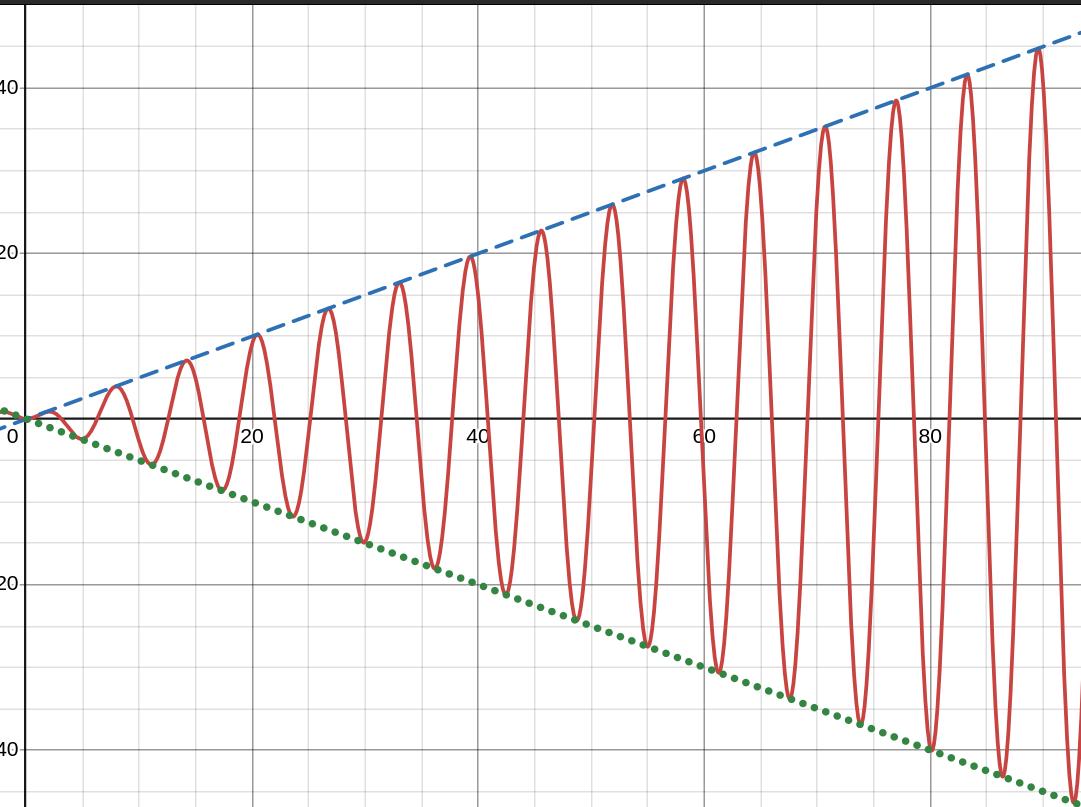
Question 134.
How do you modify portions of your educated guess when your educated guess and the solution of the associated homogeneous equation have terms of the same type?

