2026 Lecture: Kay Kirkpatrick
Cosmic funhouse telescopes and mirrors: Dark matter may be clumps of quantum particles called axions
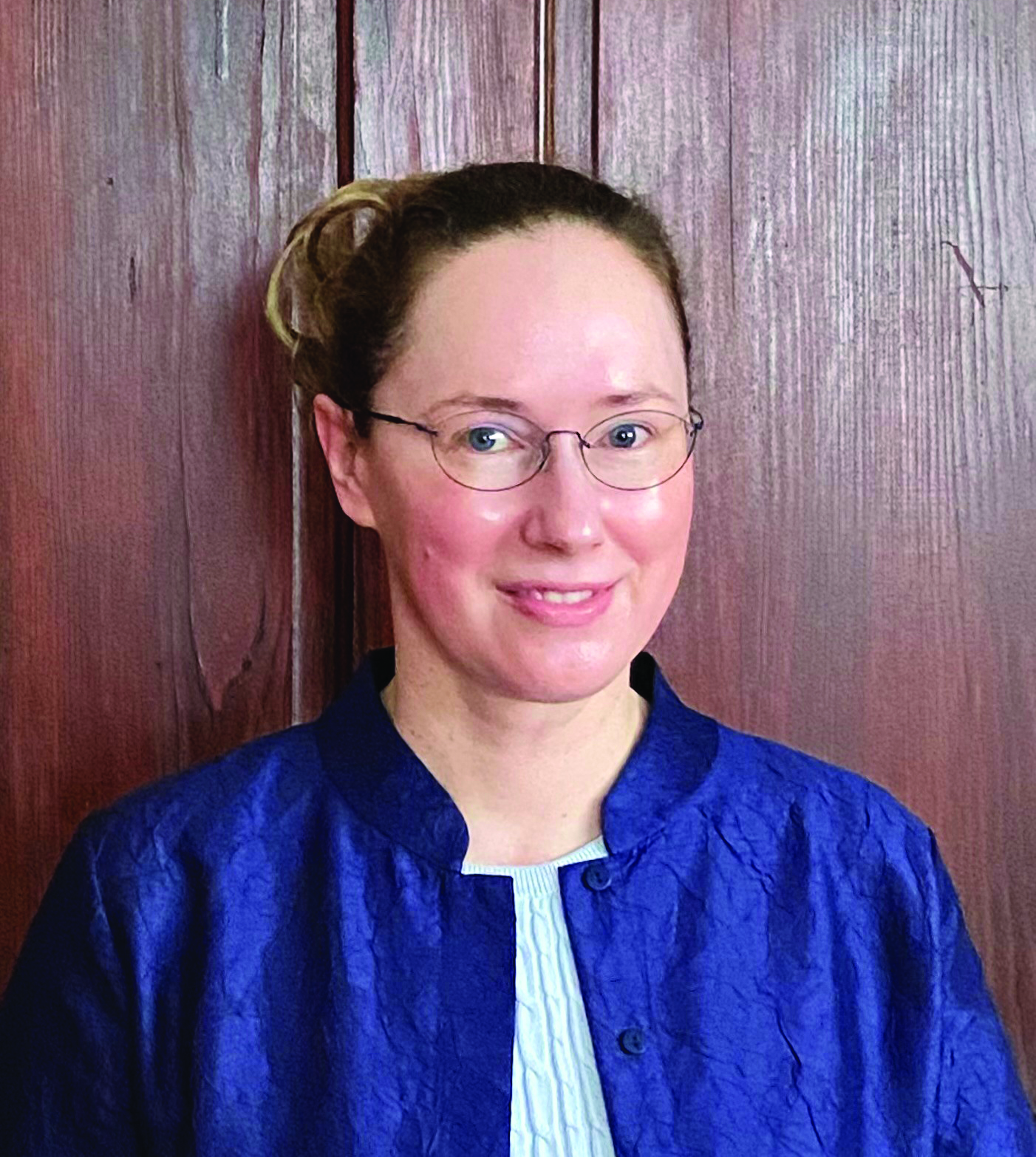
Kay Kirkpatrick is a mathematical physicist working in the fields of statistical mechanics, partial differential equations, probability, and recently, the foundations of neuroscience and computing. Kirkpatrick is a professor of mathematics and physics at University of Illinois Urbana-Champaign, where she has also been the Blackwell Scholar. She is from Montana, received her PhD from UC Berkeley, and was a postdoctoral scholar at MIT and NYU. She has been invited to be a Simons professor in the Probability and PDEs program at CRM in Montréal, and a visiting professor at Université de Paris IX Dauphine. She has also won an NSF CAREER award and a Simons Sabbatical Fellowship.
Abstract:
Dark matter is mis-named: it’s actually clear rather than dark. Throughout the sky, giant clumps of dark matter act like natural telescopes, magnifying distant galaxies and often distorting them, sometimes making them look massively stretched out—or duplicated. Among the many theories of dark matter, my favorite is the axion, a hypothetical particle that solves a PDE system involving the Gross-Pitaevskii Equation (GPE). The GPE also describes another super cool phase of matter, called Bose-Einstein Condensation (BEC). We understand BECs better than dark matter: they can be constructed in labs by cooling off a bunch of quantum particles so much that they act as one giant quantum particle. I’ll cover some theorems about BECs and about phase transitions in the underlying GPE. And then I’ll describe work pointing toward the positive resolution of the conjecture that dark matter may be condensed clumps of axions.