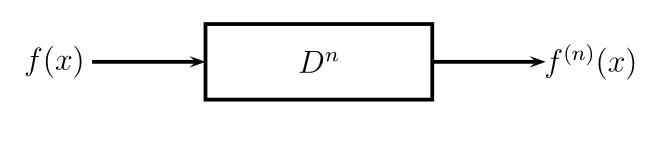
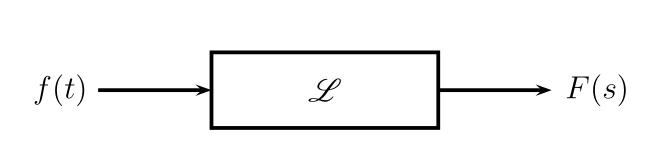
Notice that with the differential operator both the input and the output are functions of the same variable, \(x\text{.}\) With the Laplace transform operator:
With the Laplace transform operator, it is standard to use a letter to represent the input function and its corresponding letter to represent the output function. Why are we studying Laplace transforms in this class? Here is what we hope to be able to do:
We mentioned earlier that Laplace transforms are often helpful for solving differential equations when the function has a discontinuity. One way to introduce a discontinuity into a function is to multiply by a unit step function.
The Heavyside function, denoted \(u(t)\text{,}\) is defined by
\begin{align*}
u(t)\defn \begin{cases} 1, \amp \text{if } t \geq 0 \\
0, \amp \text{if } t \lt 0 \end{cases}
\end{align*}
A unit step function is a horizontal shift of the Heavyside function. More specifically, the unit step function with shift \(c\text{,}\) denoted \(u_c(t)\text{,}\) is given by
\begin{align*}
u_c(t)\defn u(t-c) = \begin{cases} 1, \amp \text{if } t \geq c \\
0, \amp \text{if } t \lt c \end{cases}
\end{align*}
The function \(f\) is piecewise continous on \([a,b]\) if there are only finitely many discontinuities in \((a,b)\) and they are all jump discontinuities. The function \(f\) is piecewise continous on \([a,\infty)\) if \(f\) is piecewise continuous on \([0,N]\) for all \(N \gt 0\text{.}\)
The function \(f\) is of exponential order as \(t \rightarrow \infty\) if there are nonnegative constants \(M\text{,}\)\(c\text{,}\) and \(T\) such that \(|f(t)| \leq Me^{ct}\) for all \(t \geq T\text{.}\)
If \(f\) is piecewise continous on \([0, \infty)\) and of exponential order as \(t \rightarrow \infty\) (with constant \(c\)), then the Laplace transform \(F(s)=\laplace{f(t)}\) exists for all \(s \gt c\text{,}\) and \(\lim_{s\rightarrow \infty} F(s)=0\text{.}\)
Let \(f(t)\) and \(g(t)\) be piecewise continous on \([0, \infty)\) and of exponential order. Let \(F(s)\) and \(G(s)\) be their respective Laplace transforms. If there is a constant \(k\) such that
\begin{equation*}
F(s)=G(s) \text{ for all } s \gt k
\end{equation*}
then
\begin{equation*}
f(t)=g(t)
\end{equation*}
for all \(t \in [0,\infty)\) where both \(f\) and \(g\) are continous.